

Privilege, p.1
Privilege, page 1


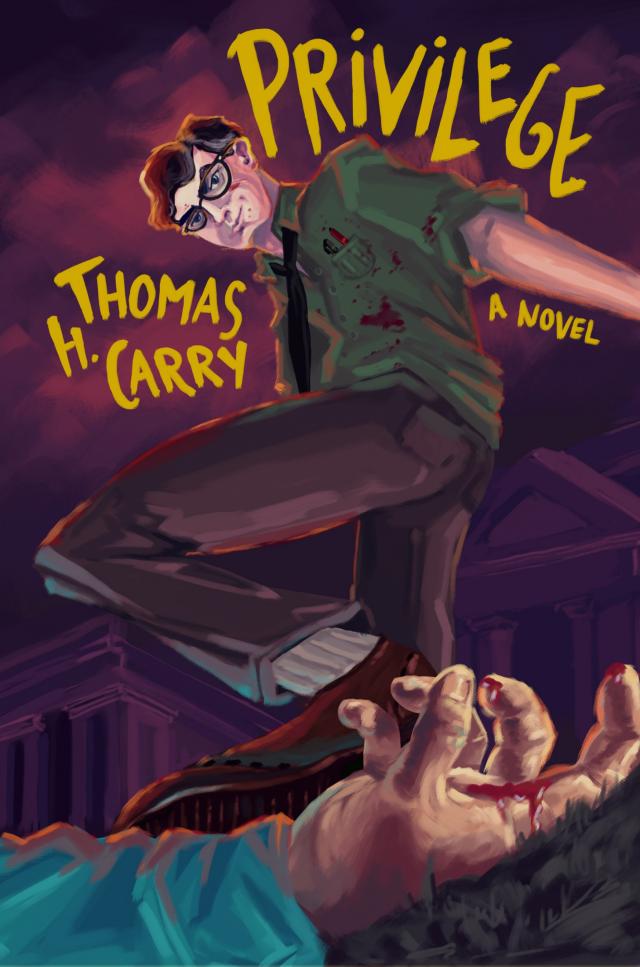
Privilege
by Thomas H. Carry
© Copyright 2020 Thomas H. Carry
ISBN 978-1-64663-035-6
All rights reserved. No part of this publication may be reproduced, stored in a retrieval system, or transmitted in any form or by any means—electronic, mechanical, photocopy, recording, or any other—except for brief quotations in printed reviews, without the prior written permission of the author.
This is a work of fiction. The characters are both actual and fictitious. With the exception of verified historical events and persons, all incidents, descriptions, dialogue and opinions expressed are the products of the author’s imagination and are not to be construed as real.
Published by
210 60th Street
Virginia Beach, VA 23451
800–435–4811
www.koehlerbooks.com
For Carrie, my parents, and steadfast friends.
Table of Contents
Prologue
Chapter One
Chapter Two
Chapter Three
Chapter Four
Chapter Five
Chapter Six
Chapter Seven
Chapter Eight
Chapter Nine
Chapter Ten
Chapter Eleven
Chapter Twelve
Chapter Thirteen
Chapter Fourteen
Chapter Fifteen
Chapter Sixteen
Chapter Seventeen
Chapter Eighteen
Chapter Nineteen
Chapter Twenty
Chapter Twenty-One
Epilogue
Prologue
A freshly dead body at your feet is a real eye-opener. It makes a person take stock, assess life choices, confront long-dormant questions repressed by time and habit. Looking back now, for example, I knew the snap decision to loop the cord tightly around her neck and silence her had its genesis in my lack of desire—my lack of passion for anything, really. Decision? No, that’s not quite right. It was more of a rending: a sudden and violent revolution overthrowing my established order. A venal jack-in-the-box, popping out of my heart and gorging on all, screeching like the baby alien in Alien—okay, sorry, that’s probably too much. Please excuse the hyperbole; I’m new to the confessional genre. You get the picture. It was a big change for me. An odd one, since I was never an overly spirited man. I lacked that flame; I was mostly steady, calm. Some would even say passive, though I think that’s taking it too far (especially now).
But lately it had been more than that, this lack. Not specific, sharp in its point, but chronic and encompassing, dull and vague; a wet tent collapsing inward. It also fed a heavy pit of resentment, one I diligently suppressed, heeding to my stoic nature. Was I masking it well? I was pretty sure my students and colleagues were oblivious to my state. I would often compensate with geniality, my raised eyebrows and open face masking my apathy. The students . . . if I’d had the commitment to hate them, I would have. Instead, they simply made me tired. Forty-three years of age, congenitally average in weight, height, and looks, I was an inoffensive man of the comfortable sort. “Danny always calms the room,” Abbie, my wife, would say in social gatherings with University colleagues. That always got smiles and nods of recognition. I was like a very pleasant virus, contagious but passing soon. People liked me.
Chapter One
I looked up from my notes and out from the lectern. The room was large, with oak and dusty plaster, sweeping up and back with fourteen inclined rows of twenty wooden chairs. The annoying patter of laptop keyboards drummed whenever I paused to throw out a question or to allow a point to sink in. The late Monday morning light struggled in through stained, drafty windows that rattled from time to time with a chilly mid-September breeze. I had a brief and irrational moment of panic, wondering if I was the actual source of the sour smell in the room—a mix of stale wood, stress perspiration, and cleaning solvents.
My course, Introduction to Film Studies, was a generally popular undergraduate class. Not because of my charismatic teaching or the students’ deep love of film history (I was no longer surprised by their film illiteracy, the mostly blank stares when I’d throw out lines from The Godfather or Manhattan). On the unsanctioned faculty review site, Tweed, students labeled me inoffensive and mildly humorous. Daniel Waite, Associate Professor of English and Film Studies, is not too hard of a grader. The course screens lots of movies, some even interesting. Moderate workload, a midterm and a final essay.
Enrollment was robust, most students checking off the humanities requirement box, several taking it as the prerequisite to the film studies major. The latter group could be the most vexing; God, had I been that pretentious as an undergraduate? Foucault discursively coupling with Norman Bates, something about fluidity, intersectionality, and power. This from Gary Fallis, a pompous, bloviating film major, who was droning on to my question about Psycho’s opening credits, citing every post-something theorist he’d likely never read.
Yes, I was perhaps touchy on the subject. I’d been obsessed with Psycho’s opening since discovering the film as a child, cross-legged in my bedroom, my face peering into the old black-and-white, an oracle of secret worlds to which I had private entry. With no cable connection in my room, the makeshift antenna’s shaky reception only added to the otherworldliness, the little screen a looking glass into a silvery land of shimmer and static. I remember first bearing witness to the credit’s linear patterns, sliced by those iconic sharp string chords, assembling and disassembling rapidly and madly. The whole landscape of Norman’s mind visually told in a tight, manic algorithm, a code I desperately wanted to break.
“The opening sequence prevents the gaze of the other, it marginalizes. It’s containing the viewer with linear force, except for that of the privileged, heterosexist subject, who is totally empowered here by that reified aesthetic. It’s so line-logical.” I gave a thoughtful nod. For fuck’s sake. Idiot. And what was he doing wearing a leather biker jacket? He’d never ridden a motorcycle in his life, I was sure of that. And that pathetic attempt at a goatee. It looked like the initial sprout of an adolescent’s pubic hair.
“That’s, ah, an interesting perspective. Does anyone want to comment on that? No?” Please? I scanned the rows; no takers, all busy with avoidance strategies.
“Okay . . . um, so you’re saying that the aesthetic of the opening credits somehow privileges the male gaze because of its linear nature. That’s a bit general, Gary, so can you drill down a bit?” Christ, please don’t. Before he could respond, the door to the room came unstuck with a loud scrape. A reverse baseball cap head popped in and sheepishly withdrew, an early student for the next class.
Gary’s puckered mouth, framed by the pubic goatee, was set to pass gas. I made quick note of the time on the large clock on the wall, directly above him. Five minutes. Why not finish a bit early? My flow was gone, the class showing its restlessness now. And I relished cutting Gary off. I took small victories where I could.
“Okay, we’ll stop here. Stay warm on this unusually cool day, and for those of you who still haven’t, please post your response papers by this evening, okay? I won’t mark them as late.” I gathered my notes from the lectern and slipped them into a worn manila folder with a half-moon coffee stain in its center. I made my way for the door, ping-ponging between students with questions, concerns, and triggers.
I stared at the empty space on my wood-paneled office wall, adjacent to my desk. Should I hang another movie poster? I had a first-print German poster of Goldfinger in storage (“James Bond ist Wieder in Aktion!”). Maybe it would be too busy. My office was cluttered already, and I’d been meaning to straighten things out, remove the stacks of paper and books that hadn’t been touched in months. Unkempt. But the thought was fatiguing. I noticed my fingernails. I should cut them soon. I picked up my iPhone and read one new text on the screen, Paul wanting to meet for lunch in the faculty dining room. I replied affirmatively. I looked out the window at students milling around like sheep on the green. Mostly looking at smartphones, walking in patterns, their shoulders stooped and chins tucked, as if their necks were too weak to carry the weight. Some hustled around a noisy group of chanters with signs yelling something indecipherable beyond the glass of the window, but the tone conveyed the message well enough: indignation, conviction, fear, and judgment. Good for you, I thought. Fight the power, stop the oppression, end the transgressions against the world you think you’re owed. Get it out of your systems before you graduate to the professional class, join the firms, become an alumni donor, and pave the way for your offspring’s legacy admissions.
Plodding among the sheep were the supposed shepherds: professors with awkward marionette bodies transporting heads to classes or to department meetings where nothing would be resolved but frivolous battles would be fought, or perhaps to institutes and centers mounting vanity projects. I despised them, the arrogant entitlement, the sandbox hierarchies, the blindness to their ineptitude beyond their narrow, dissertation-defined lanes. I know—don’t bother calling me a hypocrite: I was one of them. When properly motivated, I was a conspiring Brahmin in the caste, performing my rituals and sticking to the plan. I placed my peer-reviewed articles on the altar, did my departmental duties, gave my lectures, puckered up for the right asses, and completed my final induction into the tenure fold with the requisite overly narrow University Press book (Giving Credit: American Film Credits and the Aesthetics of Preemption, 1945-1970). How did I get here? Abbie, of course. I was, after all, a spousal hire, she being the real prize. I just came with the package (and thus avoided an exile offer in Nebraska). But that was fine—people liked me!
I first met her at the new-student meet-and-greet, recently admitted PhD students mingling with faculty and current students, compensating for nerves with peacocking intellects and ingratiating conversation. There she was: Abbie Stein holding court. One year in, she was already higher education royalty in lineage at the University. Two generations of academics preceded her there, both in medicine, both uniformly successful. “Pioneers in their fields” was a phrase I heard a lot, like it was an official title. But they were emperors, running research fiefdoms for the University, rich in grant cash and independent in authority. I was not a pioneer in my field. I had not been a star in my doctoral program, not like Abbie. The path on which I stumbled to graduate studies was not a linear one. In fact, each step of the way carried a sense of mishap, as if I had ended up lost and wandering in a large and imposing academic building, looking for the exit, but instead found myself stumbling into a classroom full of people who seemed to expect my arrival, had been patiently waiting to shout “surprise!” with perfunctory cheer. I would join the room, accept with resignation the pats and welcomes, pretend it was all my planned destination.
After all, it wasn’t all totally unfitting; I’d been an excellent student in my western Pennsylvania high school, taking honors classes. Okay, it wasn’t Andover, but even so, I did well. I suppose I got that from my Polish-American mother, who taught social studies in the town’s elementary school. She quickly saw my aptitude and worked hard to nurture it. My father, of Irish-German descent, was a union electrician and viewed me with both pride and suspicion. I even served as editor of the school’s literary magazine, Book Bears, named for the school mascot. “Hey, book bear!” my brothers would yell, leading to inevitable brawling and laughter (a high school wrestler, I usually bested them, joining in the howls).
A late arrival to the meet-and-greet, sipping from a plastic cup of sour California wine, I broke away from a stultifying conversation with a bad-breathed Victorian scholar and circled the outer perimeter of the cluster around Abbie. Her long black hair was perched back in a stylish clip. She was tall—just shy of six feet—and both willowy and athletic, half sitting on the arm of a chair, ready to spring up. She has a brown mole next to her right eyebrow. I thought it added an attractive fault to an otherwise symmetrical face—equine, Middle European, confident. She was striking, both in appearance and voice, which was rich and mellifluous. Her simple white blouse and chocolate pants were casually expensive.
“That’s brilliant! You must be excited to work with Professor Weinrich. And how about you? What are you going to focus on?” She was interviewing the group around her, the host of her own talk show, and they were smitten. I grinned, still on the periphery and enjoying the spectacle. As she talked, her eyes would alight on me, very briefly and in sync with the rhythms of her sentences.
This went on for several minutes. I held my post, a silent, grinning sentinel, until she finally landed on me, turned fully and said in that resonant voice, “Welcome!”
“Hi.”
“We were just talking about our areas; let me guess . . . Modernist?”
“American lit, mostly. Twentieth century, lit and film, actually.” I suppose I was still grinning, by the way her eyebrows shot up. The rest of the group silently watched, heads at a tennis match.
“Film!”
“Yes.” A pause. “I like to watch.”
Uncomfortable silence. No one ever got the reference to my favorite film, Being There. Her slight smile dropped suddenly; she looked at me as if I were the small print of an instruction manual; and then, just as quickly, she matched my grin, then bark-laughed, tilted her head to the side, and came down from her perch.
Walking toward me, she said: “This wine is terrible. Do you want some more? Oh, look—there’s Professor Bonner; trust me, she’s as frightening as she looks. Come! Let’s get some wine. What’s your name? I’m Abbie. Oh, good—there’s some cheese left. I’m starving! You’re not from here, are you?” By evening, we were a couple.
“There’s the Tickler with his new victim.” I looked up from my soup. Paul did a subtle head nod to his left, to a deuce top against the wall of the dining room.
“Run to the exit now!” he stage-whispered. Paul Vartan was the closest thing I had to a friend and ally (friendships had never been a top priority for me). Two decades older, he’d introduced himself at my new-faculty orientation, where he’d given a humorous, even cynical, welcome. As he spoke, he caught the conspiratorial gleam in my eye and the suppressed smile and knew he had me hooked as an apprentice to friendship. He was one of the powerful University dons, so I was lucky to have his patronage. Old-school gay, sharp-tongued and stylish, he was fast to friends, a cutting opponent toward adversaries, never forgetting a slight or worse—an Armenian gypsy with a blood feud, for whom revenge was a duty. Paul also had the institutional memory of an elephant and knew where all the bodies were buried on campus.
I played along with Paul’s theatrical gestures and looked past him to the esteemed Mark Pettersen, professor of early modern European history, author of many books I had not read, his blunt, chubby frame leaning forward on elbows as he spoke in secretive tones to a twenty-something graduate student. The Tickler, so called because of the many rumors about his proclivity to tickle his grad assistants. Despite the student’s efforts to put on her best game face, she looked like a cornered lemur. I had a momentary, sharp urge to intervene and rescue, but you’ve probably discerned I’m not that kind of protagonist, and the moment quickly passed. Pettersen continued to mumble at her, licking his thin, pale lips in between bites of his sandwich. Something white and viscous was on his chin and it made me queasy. I looked away, put my spoon down and scanned the dining room. Mumbled conversations, some solitary diners; a few disheveled adjuncts hoping the brilliant light of the tenured would shine a miracle their way; a line of faculty at the dessert table, some gleamy eyed, others resigned to paunchy swells. The white tablecloths, large-windowed views, silverware, and cushioned seats couldn’t disguise the room’s true identity as a cafeteria.
“So, things patched up with Abbie?”
Here we go.
“Well, we didn’t really need to patch anything. She’s still on me, if that’s what you mean. And I don’t blame her. I just think her expectations have to be more grounded. I’m not her. I just don’t care about the game as much—or I know I can’t really compete in it the way she’d like me to. I don’t know.”
“Well, you haven’t exactly been Johnny Lively lately,” Paul said. “I don’t know why; things are going well for you! You don’t have to go out and win a Nobel. I don’t think anyone’s saying that.” He looked at me with a mix of concern and expectation, trying to mask it with a casual lightness while fussing with his napkin. “I see your class is well enrolled—how is that going?”
“Seriously?”
“Well, come on! You have to get motivated for something. You just need to get your groove back.” I’d never had a groove and didn’t want one now. “Are you working on that article?”
“If by working you mean rewriting the same paragraph, every day, for the past two months, then yes.”
“Give me a break. What am I going to do with you? Are you going to the conference with Abbie?”
“Again, seriously? Of course I’m not.”
“It’s Santa Monica—it will be pretty! You really need to stop this. You’re becoming a big, fat bore. Well, not literally fat. Don’t give me that hurt puppy look.”
“Well, my pants are a little tighter—why do you think I’m having soup and salad for lunch? See, I’m not totally unmotivated. Proud of me? And no, I’m not going to troll around the conference carrying Abbie’s books. She doesn’t want me there anyway. I’m an unnecessary distraction.”
I had hated academic conferences ever since my first one as a doctoral candidate, getting out there for the pending job market and giving a paper on movie credits. The three days of panels and meetings left me with a feeling akin to severe iron deficiency. At the end, a vortex of pinched faces and endless jargon-speak culminated in a reception and dance for the conference participants: gyrating, spastic academics undermining simple pop beats. Sweating, undulating, flailing with abandon, horrifying. I still bore emotional scars.






