Mark my words, p.1
Mark My Words, page 1
part #3 of Mason Dixon Series


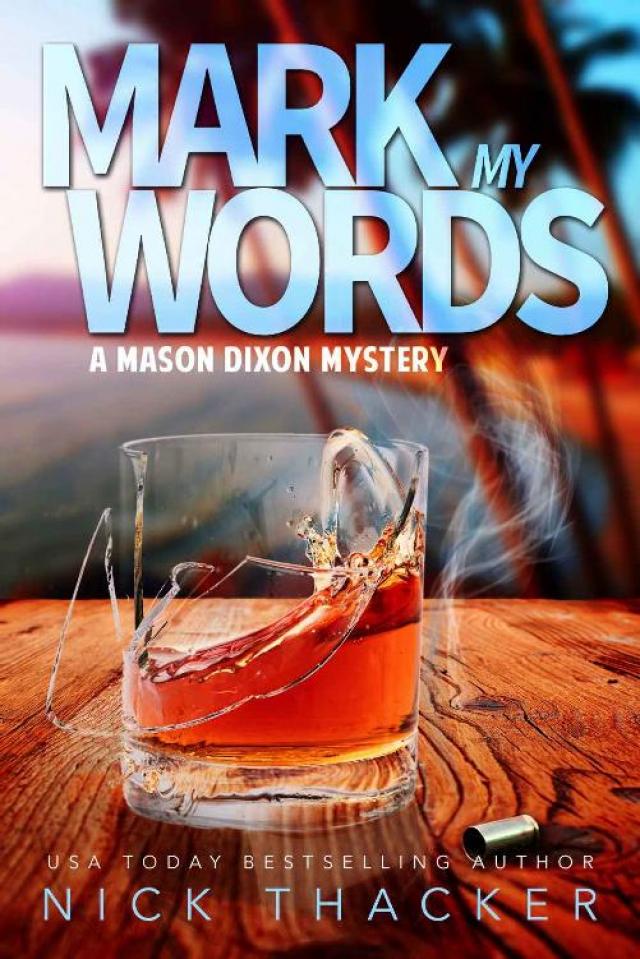
Mark My Words
Nick Thacker
Contents
Chapter 1
Chapter 2
Chapter 3
Chapter 4
Chapter 5
Chapter 6
Chapter 7
Chapter 8
Chapter 9
Chapter 10
Chapter 11
Chapter 12
Chapter 13
Chapter 14
Chapter 15
Chapter 16
Chapter 17
Chapter 18
Chapter 19
Chapter 20
Chapter 21
Chapter 22
Chapter 23
Chapter 24
Chapter 25
Chapter 26
Chapter 27
Chapter 28
Chapter 29
Chapter 30
Epilogue
Afterword
Classy Drinks for Classy People
Introduction
Chapter 1
Chapter 2
Chapter 3
Chapter 4
Chapter 5
Also by Nick Thacker
About the Author
1
There comes a time in every man’s life when they wonder to themselves whether it was worth it or not to kill all those people.
Okay, fine. Maybe not every man’s life, but at least in mine, that’s where I’m at. Wondering, deciding, convinced that I’ve made a mistake once or twice over the years. Killed a guy — or gal — who wasn’t bad.
I'm good at two things. Making drinks is one of them. Killing bad guys is another. I prefer one of them, but I would never admit that to anyone.
I mean, how do you know? Were they all bad? And if all of them weren’t bad, were the ones that were bad all bad? Or were they only partly bad? And was the bad part of them worth killing them? I've definitely offed some of the genuinely all-bad ones, and I've made the world a better place because of it. That's a fact.
But I've got a sense that maybe there should have been more to it. Perhaps they just hadn't ever been faced with their own mortality before. Had they had that opportunity like I've had many times over, might they have changed their ways?
Not to wax philosophical, but that's the kind of crap I think about all the time, and I have plenty of time to do it. I own a bar (well, the bank owns a bar, and they let me put my name on it), so it's a good thing I'm good at mixing drinks. I can pour like a pro, but my real passion is mixing up a fine concoction of delectable nectar and nailing the presentation.
Most of the orders that hit us, however, are the typical I’m-not-sure-but-my-old-man-used-to-drink-these drinks that I can make with my eyes closed and my hands tied behind my back, so I’ve got plenty of time to think through my own opinions about the meaning of life.
Joey, my barman, manager, cook, and all-around worthy sidekick, knows when I’m in a particular moment like this and usually allows me to finish my thought. But he also knows — somehow — what it is I'm thinking about, and more often than not he even knows my opinion about that thing I'm thinking.
Happened last night. We were in the bar. I was waiting and serving, and Joey was in the back whipping up his now-famous (at least in Edisto Beach, South Carolina) breaded catfish nuggets (more breaded than nuggeted), and I was thinking about the reason I’d done the things I’d done, and trying to figure out what I thought about all of it.
Joey came out with an order, slid it down the bar and gave me a wink, which meant the order was on the house, intended for someone he knew, and then started to turn away.
“Something on your mind, boss?” Joey asked, just before he had whirled away and started back toward the kitchen.
I grunted — my usual mechanism of mid-thought verbal self-interruption — and nodded. "Just… you know."
“Trying to figure out if it’s all worth it? If those guys didn’t deserve it after all?”
I made a clicking sound with the insides of my cheeks, squinting down at him — he’s almost a head shorter than I am — and he smiled.
“How the hell you do that, Joey?” I asked.
“Do what?”
“Knock it off. You know exactly what I’m talking about.”
The order was still on the bar, and I usually wouldn't have allowed it to get more than thirty seconds of cold before it reached the designated eater. But since this one was a ‘winker' and that designated eater was his girlfriend, Shalice, whom I'd spotted in the corner earlier, I let it pass and turned my attention back to Joey.
He made eyes at Shalice, who gave him a glance that could only mean, hurry up with my food.
I smiled, wondering when these two lovebirds were going to tie the know. After everything they'd been through, I figured they'd be inseparable. I didn't realize that meant she would be in the bar just about every night Joey was working.
He shrugged, wiping his hands on the sides of his apron. “I guess I’m just really in tune with your most intimate thoughts, man.”
I made my squint squintier, adding in a nice Clint Eastwood-style lip turn (another trademark of mine), and shook my head. “You wish.”
He sniffed. “Look, brother, I think about that stuff too. All the time. It’s not that strange, you know. What we do — you know, it’s not exactly light on the mind.”
“Right. So what do you make of it?”
“Just… maybe that it doesn’t matter.”
“Joey, that’s probably the single most unhelpful thing you’ve ever said.”
“No, hear me out boss,” he said. “I’m saying it matters, but once it’s done, it doesn’t. It can’t. We vet, we wait for a mark, then we move. That’s it. You do your due diligence, I do mine, and we trust each other. You’re a good guy, and — I think — I am too, so that’s that.”
I turned around and grabbed a bottle of Hornitas Black Barrel, a new favorite of mine, and poured two lowballs. I’m not generally a fan of tequila, but there was a certain and delicious whiskey-ness to this one, as it had been aged in charred oak barrels and had that wonderful caramel and vanilla flavor I can’t get enough of. Joey sidled up to one of the two stools we kept behind the bar for just this purpose, apparently done with his bread-nugget orders.
We both took a slow, long sip — another reason I love this tequila: it demands slow drinking, and shooting it is more wasteful than trying to sip through a sieve. He closed his eyes and smiled.
“So you’re saying that we’re the good guys, and since we’re good, they were all bad.”
He shrugged again. “Maybe. I guess. I don’t know. I just think that since we’re not the bad guys, anyone trying to do us in, or screw with us, probably ain’t good enough to worry about.”
“You’re making a lot of assumptions.”
“You’re thinking a lot of assumptions.”
“Fair enough,” I said. “But still — how can we know? How do I know that when I’m dead and gone, I’ll be able to stand in front of those pearly gates and say with all honesty that I’ve done okay down here?”
“Didn’t ever strike you for the religious type, boss,” Joey said.
“Didn’t ever ask,” I answered. It sounded harsh, so I added a bit of clarity. “I grew up Catholic. Mom was devout, but Dad was a bit… unrefined. He never really took to it, and then with my brother…”
I didn’t need to finish. He knew the rest of the story — that my little brother was a bit more eccentric and artistic than my old man thought necessary for a young man, and often accused him — with no attempt at subtlety or understanding — of being homosexual.
For what it’s worth, it never bothered me in the slightest whether he was or wasn’t some thing or another. He was my brother. He was family.
Dad, on the other hand, wasn’t so easily smitten with the idea. The verdict was still out, but Dad had essentially written off his second son as worse than the proverbial prodigal one. The verdict also was still out whether this prodigal would be received with open arms, should they ever had the unfortunate opportunity to reunite.
“You think this place shouldn’t belong to you?” Joey asked.
I looked at him oddly.
“I mean, you’re not one to really give a hoot about your own life, but when it comes to your bar…”
He was right. I didn't give two hoots of a damn about myself most of the time, but as soon as you crossed me on my own property…
“I guess,” I said. I thought about his question again. “Yeah, I think you’re right. I feel like I — we — worked tooth and nail for this little slice of paradise, and yet sometimes I wonder if it was worth everything we gave. If what we had to do to protect it was… right."
He nodded slowly. “Yeah, probably best not to wonder about things like that.”
“Can’t help it.”
He stopped me, waited for me to look at him. "Look, Mason. I think life is important and all because it was given to us. It's necessary. But there’s little reason to enjoy life if there’s nothing to enjoy about it.”
“So owning a bar is the reason for my life?”
He laughed. “Maybe. But probably not. I just think that protecting this place, putting what you’ve put into it to make it yours, working every day in here to make sure it was you. It’s a part of you now. It is you now.”
“Nice sentiment, but the bank owns it.”
“True. But that’s just the game — you have to play the game. The point is, this place is worth fighting for. No matter how you feel about yourself, or the res t of your life, it’s worth it.”
I nodded. “I’m just thinking a lot lately, that’s all,” I said, feeling the awkwardness that had been suddenly injected into the conversation and wanting to disappear it. “It’s nothing. Just trying to sleep at night.”
“You’ve never in your life had trouble sleeping at night,” Joey said.
He couldn't have been more wrong, but for all he knew of my private life I had always been Sleeping Beauty. Since I'd met Joey, he'd taken it upon himself to give me grief for the number of hours I sleep, even though he knew they were solid and sound. Around four hours on weekdays, five on weekends.
When you’re my age, you just don’t need that much sleep. I don't know, science I guess.
“Well let’s just say I’ve been thinking a lot about the choices I’ve made. Wondering if they’d be any different if I knew who they all were, each time. Like really knew.”
“Probably,” Joey said, as unhelpful as ever. “If we knew everything about everybody, we’d probably tear ourselves apart just trying to figure out how to talk to them, much less how to —”
“Get a drink down here?”
The voice came from my left, and I involuntarily stood up and walked over. “Sorry about that,” I said. “Didn’t see you come in.”
2
It was a lie, of course. I see everyone who comes in.
But I didn’t want to let on that aside from the little bell above the door that alerted us to new arrivals, I had a multiview security monitor set up just beneath the bar. I had watched the tall, slightly overweight guy open the door, look both directions, and then walk straight toward the bar.
He wasn’t alone, either. He’d entered with another guy. Smaller in every way, even his eyes were beady and scared. He turned to his left immediately upon entering my space and found a seat that was not only empty but not close to any other guests. He was facing the door, kind of, but the look on his face told me that he wasn’t facing any particular direction for any particular reason.
The thing about people who visit bars like mine — small-town, out-of-the-way dives that fall somewhere between hole-in-the-wall mom-and-pop setups struggling for rent payments each month and your local neighborhood chain restaurant bar — is that people don’t come in for no reason.
They're here to see a friend, or they're here because they want some real, live, human interaction they're not getting in their lonely bungalows where they spend the rest of their lives. These are the locals, the ladies and gents who know Joey or me and like us enough to patronize our establishment because, hell, their friends are bartenders. Most people fall into one of the two categories, but there's a third when it comes to bars like mine: tourists.
Tourists are easy to spot anywhere, but especially in Edisto Beach, South Carolina, since it’s a small enough place that everyone knows everyone’s dog, and it’s only a matter of a quick phone call to get the owner to head over and pick it up. Tourists, however, stand out like a raised pinky on a wine glass. They think they have to act elegant, or gawky, or at least surprised by every little thing that’s not the exact same way that thing is like from whence they’ve come. They smile at me like they’re watching their two-year-old niece mash Play-Do through the teeth of a comb, and they order drinks like I’m a shiny, shirtless Bora Boran on the white sandy beach resort they wish they were at.
Pina Coladas, Mai Tais, Bahama Mamas, anything rhyme-y and fruity-sounding. ‘Rum and Coke with a lime, because oh-my-word my neighbor Marjorie went to Aruba and that’s how they do it there.’
…It’s called a Cuba Libre, Susan, and it’s how everyone does it.
Anyway, this guy who came in and walked up to my bar was clearly not a tourist, and his little buddy sitting scared in the corner wasn't, either. The bigger guy didn't have the fanny-pack gut or the overpriced camera-strap neck. He'd looked around like he already knew the place, but I'd never seen him before, and in a town of 800 people (on paper) I'd seen everyone before.
So when he’d walked straight toward the bar, waiting until he’d sat down and gotten settled, ignoring everything in the world except for my conversation with Joey and waiting until the perfect moment to interject his question.
“Got it, boss?” Joey asked.
I nodded, already facing toward the new arrival and away from Joey. “Why don’t you check the fryer?” I asked.
Joey nodded. I didn’t see it, of course, but I knew that he did. It was code for, ‘we got a mark, and you need to get the shotgun.’
If I haven’t mentioned it yet, I’m out of the business. After my old man got us involved in a high-speed boat chase and subsequent freighter explosion off the coast of Charleston, I’d decided — finally — to throw in the stained bar towel.
I was done.
Joey was done.
Shalice, the girlfriend still waiting for her now-cool fish nuggets and chips, had been nabbed from my boat, the Wassamassaw, which previously had been her father’s boat, and then her boat, and held captive on the aforementioned soon-to-be-exploded cargo freighter.
If it weren't for the shitty life and questionable way of making a living, it would have been for her. And for Joey. And before them, it would have been for Shannon.
But deep down it had been for me. I alone had decided that I was done, and I’d decided it long before my father had roped me back in.
So now, whenever there was a person who fell into that small, niche fourth category of visitor to my bar — the marks — trying to lure us back into the game, Joey and I had an understanding. He’d watch the second camera bank on the monitor in the kitchen, wait for something to happen, then rush out with the Remington and start acting like the badass I knew he was.
I had my own piece under the bar top, so I was prepared at all times for such an occurrence, but so far hadn’t needed to use it.
I gave him the slight head-lift worn by the more youthful hipster bartenders — the ‘sup, whatcha want?' back-nod — and waited. No sense being overly polite to this joker since I'd pegged him as trouble the second he'd stepped over the threshold.
He could have been a mark — he fit the bill, physically — but I knew my old man was not operating any longer. He wouldn’t have sent a mark to me.
Because it was impossible to send a mark to someone if you were dead.
So this guy was something else, and that terrified me. He was an unknown, and in my lines of work — bartending and killing bad guys — fear of the unknown is a significant cause of anxiety.
And sometimes a major cause of death.
“Whiskey, on the rocks.”
This was interesting. I put the comma in there for him, but he said it. ‘Whiskey… pause… on the rocks.’
‘Whiskey on the rocks’ was a drink ordered by a guy who knew how he liked it. He was confident, sure of himself, understanding of my job and the nature of what it meant to order something strong but discerning enough to want it chilled and diluted just a bit.
‘Whiskey, comma, on the rocks,’ was a different drink. It was a drink meant for someone who wanted something quick, to get the drink-ordering business out of the way and get on with the important stuff, the task at hand. It was whiskey, because the guy probably liked whiskey enough to want it or it was at least something easy and quick to think about and say, but it was… pause… on the rocks. The pause part is what, ironically, gives me pause. They’re deciding how they want their whiskey.
If they know what liquor they want, they probably already know how they like it. No one orders Jack Daniels and then decides they want it the way they always have it: on the rocks, neat, with a twist, whatever. They already know.
So for a ‘whiskey, on the rocks,’ it meant the guy wasn’t here for a drink. I’d pour him a whiskey from the deepest well I had, throw in two ‘rocks,’ and slide it across. I’d serve him, of course — I’m not a barbarian — but he wasn’t here for the drink.