Full tilt, p.1
Full Tilt, page 1


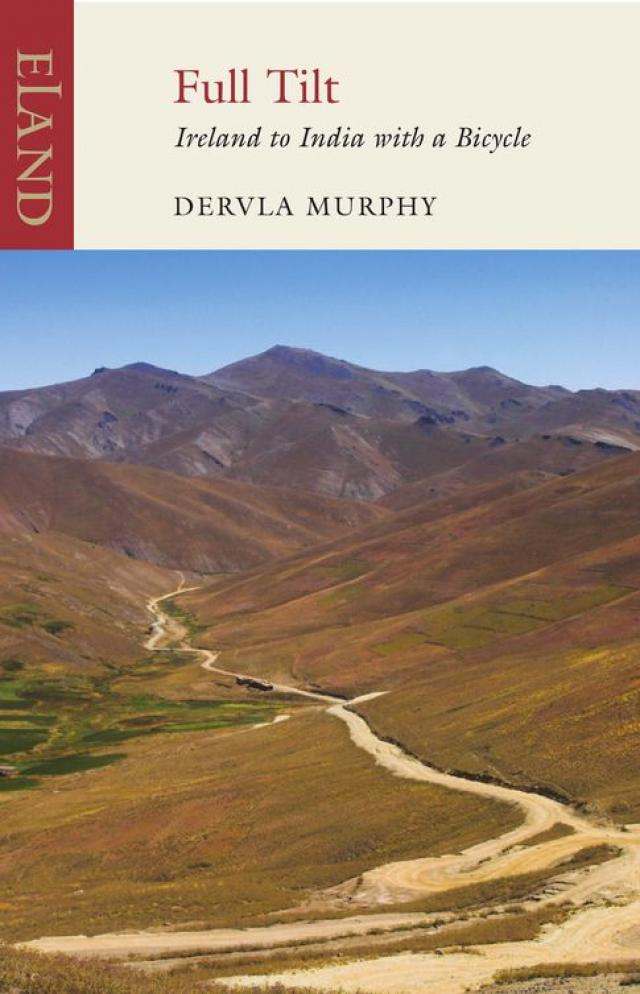
Full Tilt
Ireland to India with a Bicycle
‘She avoided wolves (animal and human), floods, robbery, had three ribs broken in a brawl in an Afghan bus; waded across an ice torrent, hugging a cow … suffered extremes of heat and cold, ate everything, liked almost everybody.’
Homes and Gardens
‘This vivid journal … would have delighted Cervantes with its almost incredible surprises: a valley full of birds the size of butterflies and butterflies as big as robins; a village where the cattle eat apricots and the villagers eat clover … Somewhere between Kabul and Jalalabad, she thought she was dreaming when she awoke from a roadside nap to find that nomads had raised a tent over her to shield her from the sun.’
The New Yorker
‘I don’t know when I’ve enjoyed the account of a journey more. A great part of the enchantment of her book is that it is so good humoured and so funny. I laughed … and learned a good deal … one follows her with pleasure … a brave, intelligent, rare and amusing human being.’
Margaret Lane
‘A journey fraught with incalculable hardships and perils. It is unexpected, but then everything Dervla Murphy does is unexpected … an enchantment that holds the reader as engrossed as would an exciting thriller.’
Irish Independent
‘Warmly described, and with a lack of self-regard that immediately endears her to the reader.’
Sunday Times
‘Punctures, broken ribs, hornets and scorpions notwithstanding, it was a high old time between Miss Murphy and her Islamic hosts … her book is sensible, warm-hearted, unfinicky.’
The Observer
Full Tilt
Ireland to India with a Bicycle
DERVLA MURPHY
To the peoples of
Afghanistan and Pakistan,
with gratitude for their hospitality,
with admiration for their principles
and with affection for those who befriended me
Contents
Title Page
Dedication
Foreword
Epigraph
Maps
Introduction to the Journey
DUNKIRK TO TEHERAN
1 The Elusive Visa
TEHERAN
2 Hospitality of the Police
TEHERAN TO THE AFGHAN FRONTIER
3 Compulsory Bus Rides
HERAT TO KABUL
4 Misadventure with a Rifle-butt
KABUL TO BAMIAN
5 The Oddities of Afghan Trucks
BAMIAN TO PUL-I-KHUMRI
6 A Medical Break
PUL-I-KHUMRI TO JALALABAD
7 Anticlimax
JALALABAD TO PESHAWAR
8 Welcome at the Waliahad
PESHAWAR TO SAIDU SHARIFF
9 Sweating out of Swat
SAIDU SHARIFF TO RAWALPINDI
10 Scraping through the Himalayas
RAWALPINDI TO GULAPUR
11 From One Saddle to Another
GULAPUR TO SHER QUILA RAKAPOSHI
12 Duel with the Sun
SHER QUILA RAKAPOSHI TO BABUSAR
13 Two Wheels over Nine Glaciers
BABUSAR TO ABBOTTABAD
14 Running Repairs
ABBOTTABAD TO LAHORE
15 Out of the Saddle
LAHORE TO DELHI
List of Kit
About the Author
Index
Copyright
Foreword
On my tenth birthday a bicycle and an atlas coincided as presents and a few days later I decided to cycle to India. I’ve never forgotten the exact spot on a hill near my home at Lismore, County Waterford, where the decision was made and it seemed to me then, as it still seems to me now, a logical decision, based on the discoveries that cycling was a most satisfactory method of transport and that (excluding the USSR for political reasons) the way to India offered fewer watery obstacles than any other destination at a similar distance.
However, I was a cunning child so I kept my ambition to myself, thus avoiding the tolerant amusement it would have provoked among my elders. I did not want to be soothingly assured that this was a passing whim because I was quite confident that one day I would cycle to India.
That was at the beginning of December 1941, and on 14 January 1963, I started to cycle from Dunkirk towards Delhi.
The preparations had been simple; one of the advantages of cycling is that it automatically prevents a journey from becoming an Expedition. I already possessed an admirable Armstrong Cadet man’s bicycle named Rozinante, but always known as ‘Roz’. By a coincidence I had bought her on 14 January 1961, so our journey started on her second birthday. This was ideal; we were by then a happy team, having already covered thousands of miles together, yet she was young enough to be dependable. The only preparation Roz needed was the removal of her three-speed derailleur gear, which I reckoned would be too sensitive to survive Asian roads. Apart from the normal accessories – saddle-bag, bell, lamp and pump – she carried only pannier-bag holders on either side of the back wheel. Unloaded she weighs thirty-seven pounds and at the start of the journey she was taking twentyeight pounds of kit while I carried another six pounds in a small knapsack. (A list of kit is given on page 231.) Before leaving Ireland, four spare tyres had been posted ahead to various British Embassies, Consulates and High Commissions en route; Roz takes 27½" x 1¼" tyres, which are not a standard measurement abroad.
In London, at the end of November 1962, I obtained without difficulty visas for Yugoslavia and Bulgaria; I planned to get my visas for Persia in Istanbul and for Afghanistan in Teheran. During the same visit to London I endured vaccinations and inoculations for smallpox, cholera, typhoid and yellow-fever – the latter in case I decided to return from India via Africa.
Most of the following month was spent bending over maps bought through the AA in Dublin, working out the distances between towns which had intoxicatingly improbable names. I calculated that it was 4,445 miles from Dunkirk to Peshawar, and by New Year’s Eve I could have told you without hesitation where I planned to be on any given date between 14 January and 14 May, when I hoped to arrive in Peshawar. The object of this exercise was to ensure that my mail – sent care of the British Council offices en route – would not miss me; nor did it, despite many inevitable changes in my original plans.
In the intervals between mapping I took myself off to remote areas in the mountains around Lismore and practised firing and reloading my ·25, the purchase of which had recently been achieved with the full and rather awe-struck co-operation of the local police. My friends regarded this purchase as so much adolescent melodrama on my part but fortunately I ignored their criticisms and stuck to my gun, though its presence in the right-hand pocket of my slacks – where I habitually carried it to accustom myself to the presence of a loaded weapon – frightened me considerably more than it did anyone else. Yet within a month of leaving home the seemingly childish game of whipping it out of my pocket and flicking up the safety catch was fully justified.
I arrived in Delhi on 18 July 1963, almost six months after leaving Ireland. People with mathematical brains are always anxious to know exactly how many miles I had cycled by then and what my daily average was. Unfortunately gadgets for measuring mileage do not function on Asian roads, so I can only estimate vaguely that Roz and I covered about three thousand miles, including our detours to Murree and Gilgit. From this the mathematically inclined can easily calculate our average daily mileage, but their findings would be slightly misleading, because there were so many days when we did not cover even a mile together. Our shortest run was, I think, nineteen miles, and our longest 118 miles, but I reckon that our average on a normal cycling day was between seventy and eighty miles.
This is perhaps the moment to contradict the popular fallacy that a solitary woman who undertakes this sort of journey must be ‘very courageous’. Epictetus put it in a nutshell when he said, ‘For it is not death or hardship that is a fearful thing, but the fear of death and hardship.’ And because in general the possibility of physical danger does not frighten me, courage is not required; when a man tries to rob or assault me or when I find myself, as darkness is falling, utterly exhausted and waist-deep in snow halfway up a mountain pass, then I am afraid – but in such circumstances it is the instinct of self-preservation, rather than courage, that takes over.
For the first two months of the trip I struggled hard to keep my four closest friends informed of my progress through letters but the effort was too much; so from Teheran onwards I adopted the diary-keeping method used by most travellers and sent instalments home whenever a reliable-looking post office appeared en route. My friends circulated these instalments amongst themselves, the last on the circuit line storing the manuscript away for future reference. This book is the ‘Future Reference’.
Apart from burnishing the spelling and syntax, which are apt to suffer when one makes nightly entries whether half asleep or not, I have left the diary virtually unchanged. A few very personal or very topical comments or allusions have been excised, but the temptation to make myself sound more learned than I am, by gleaning facts and figures from an encyclopaedia and inserting them in appropriate places, has been resisted. For this reason the narrative which follows will be seen to suffer from statistic-deficiency; it only contains such information as any traveller might happen to pick up from day to day along my route.
After arriving in Delhi I worked for six months with the Tibetan refugees in northern India and then enjoyed a few more treks with Roz in t he Himalayas and in south-west Nepal, before submitting to the degradation of flying home on 23 February 1964, with a dismantled Roz by my side as ‘personal effects’.
My thanks go in many directions: to the British and American consular officials in those countries where Ireland is not diplomatically represented, who adopted and cared for me as though I were their own; to the scores of individuals and families in every country on my route whose boundless hospitality taught me that for all the horrible chaos of the contemporary political scene this world is full of kindness; to the chance friends I made in odd places, whose names I never knew or have forgotten but whose companionship made a sometimes lonely journey much more pleasant; and last, but certainly not least, to Daphne Pearce, who suggested the title and gave invaluable help in editing the manuscript; to Patricia Truell, who compiled the index and guided me through the ordeal of correcting my first proofs; and to my other friends in Ireland, who loyally and patiently read over 200,000 words in an execrable hand and whose interest in my experiences was both the inspiration and the reward of keeping this diary.
For my part I travel not to go anywhere, but to go. I travel for travel’s sake. The great affair is to move, to feel the needs and hitches of our life more nearly, to come down off the feather-bed of civilization and find the globe granite underfoot and strewn with cutting flints.
ROBERT LOUIS STEVENSON
Introduction to the Journey
DUNKIRK TO TEHERAN
I had planned a route to India through France, Italy, Yugoslavia, Bulgaria, Turkey, Persia, Afghanistan and Pakistan. Departure Day was to have been 7 January 1963, but by then the freak weather of that year had reached even Ireland and I postponed ‘D-Day’ for a week, innocently supposing that these conditions ‘could not go on’. But of course they did go on, and in my impatience to be off I decided that to postpone departure from week to week would not be practical – though in retrospect I realised that it would have been a lot more practical than heading for Central Europe during the coldest winter in eighty years.
I shall never forget that dark ice-bound morning when I began to cycle east from Dunkirk; to have the fulfilment of a twenty-one-year-old ambition apparently within one’s grasp can be quite disconcerting. This was a moment I had thought about so often that when I actually found myself living through it I felt as though some favourite scene from a novel had come, incredibly, to life. However, within a few weeks my journey had degenerated from a happy-go-lucky cycle trek to a grim struggle for progress by any means along roads long lost beneath snow and ice.
At first my disappointment was acute, but I had set out to enjoy myself by seeing the world, not to make or break any record, so I soon became adjusted to these conditions, which led to quite a few interesting adventures. Also, I was aware of ‘seeing the world’ in circumstances unique to my generation. Should I survive to the end of this century it will be impressive to recall that I crossed the breadth of Europe in the winter of 1963, when every humdrum detail of daily life was made tensely dramatic by the weather and going shopping became a scaled-down Expedition to the Antarctic. It was neat hell at the time – I cycled up to the Rouen Youth Hostel with a quarter-inch icicle firmly attached to my nose and more than once the agony of frozen fingers made me weep rather uncharacteristically – yet it seemed a reasonably good exchange for the satisfaction of cycling all the way to India.
I give full marks to Italy for the superb efficiency with which her main northern roads were kept clear during that January. Having been compelled to take a train from Grenoble to Turin, across the Alps, I found myself able to cycle, and enjoy it, almost all the way to Nova Gorizia, through a deserted and impeccably beautiful Venice.
At this bisected frontier town of Nova Gorizia the formalities for being admitted into Yugoslavia seemed diabolically complicated. Repeatedly I was shuttled back and forth through the darkness from Police to Customs Officers; then, while innumerable forms were being completed in triplicate, I stood shivering outside warm offices, trying to explain why I was so improbably entering Yugoslavia with a bicycle on 28 January. And every time I took off a glove to sign yet another document the bitter wind seared my hand like caustic acid.
Suddenly a policeman shouted to someone in another room and a tall, rugged-featured woman, wearing Customs Officer’s uniform, appeared beside me. I stared at her in horror, only then remembering that my automatic lay in the right-hand pocket of my slacks, where the most casual search would at once detect a sinister hard object. In the stress and strain of searching Gorizia for the open frontier post (there were four in all, but three were closed to tourists) I had quite forgotten my ingenious scheme for concealing the weapon. So now I foresaw myself being hurled into the nearest dungeon, from which I would eventually emerge, emaciated and broken in spirit, after years of negotiations between two governments who are not, diplomatically, on speaking terms. But alarm was unnecessary. The formidable female took one quick look at my intricately laden bicycle, my knapsack with its protruding loaf of bread and my scruffy self. Then she burst into good-humoured laughter – of which one would not have believed her capable – slapped me on the back and waved me towards the frontier. It was 6.15 p.m. when I passed under the railway bridge with ‘Jugoslavija’ painted across it in huge letters.
Two miles from the frontier, having cycled along an unlighted road that leads away from Italy and then curves back, I came to Nova Gorica, the Yugoslav half of the town. Here, beneath the weak glow of a street lamp, a solitary figure was walking ahead of me. Overtaking it I saw a good-looking girl who, in reply to my questions, said, ‘Yes’ she spoke German, but ‘No’ there wasn’t a cheap inn available, only the Tourist Hotel, which was very expensive. Even in the dim light my look of dismay must have been apparent, because she immediately added an invitation to come home with her for the night. As this was within my first hour of entering Slovenia I was astonished; but soon I learnt that such kindness is common form in that region.
While we walked between high blocks of workers’ flats, Romana told me that she shared a room with two other typists employed in a local factory at £3 per week, but as one was away in hospital there would be plenty of space for me.
The little room, at the top of three flights of stairs, was clean and adequately furnished, though the only means of cooking was an electric ring, and the bathroom and lavatory were shared with three families living, in one room each, on the same floor. Arita, Romana’s room-mate, gave me a most enthusiastic welcome and we settled down to a meal of very curious soup, concocted out of some anaemic meat broth, in which lightly whipped eggs were cooked, followed by my bread and cheese (imported from Italy) and coffee (imported from Ireland).
I found these youngsters delightful company – vivacious, perfectly mannered and intelligent. They were simply dressed and it was pleasant to see their clear-skinned faces, innocent of any make-up, and their well-groomed heads of unpermed sanely-cut hair. I noted too the impressive row of books in the little shelf by the stove – among them translations of Dubliners, The Heart of the Matter, The Coiners, Black and Red and The Leopard.
Anticipating a tough mountain ride on the following day I was relieved to find that 9.30 p.m. was bedtime, as these girls rise at 5.30 a.m. to catch the factory bus and be at work by seven o’clock.
It was a deceptively fine morning when I left Nova Gorica. The second-class but well-kept road to Ljubljana wound through a range of fissured mountains, whose lower slopes were studded with tiny villages of brown-roofed, ramshackle farmhouses, and whose upper slopes, of perpendicular bare rock, gave the valley an odd appearance, as though it had been artificially walled in from the rest of the world. Then, towards midday, as I was revelling in the still, crisp air and brilliant sunshine, a violent wind arose. Whether because of the peculiar configuration of the mountains here, or because it was one more manifestation of freakish weather, this wind blew with a force such as I had never previously encountered. Before I could adjust myself on the saddle to do battle with my new enemy it had lifted me right off Roz and deposited me on a heap of gravel by the wayside. None the worse, I remounted, but ten minutes later, despite my efforts to hold Roz on the road and myself on Roz, we were again separated, and this time I went rolling down a fifteen-foot sloping ditch, unable to get a grip on the icy bank to check my fall. I ended up on a stream which happily was frozen so solid that my impact produced not a crack in the ice. After crawling cautiously along the stream for some twenty yards, to find a way up to the road and Roz, I decided that from now on walking was the only logical means of progress.