Were here, p.1
We're Here, page 1


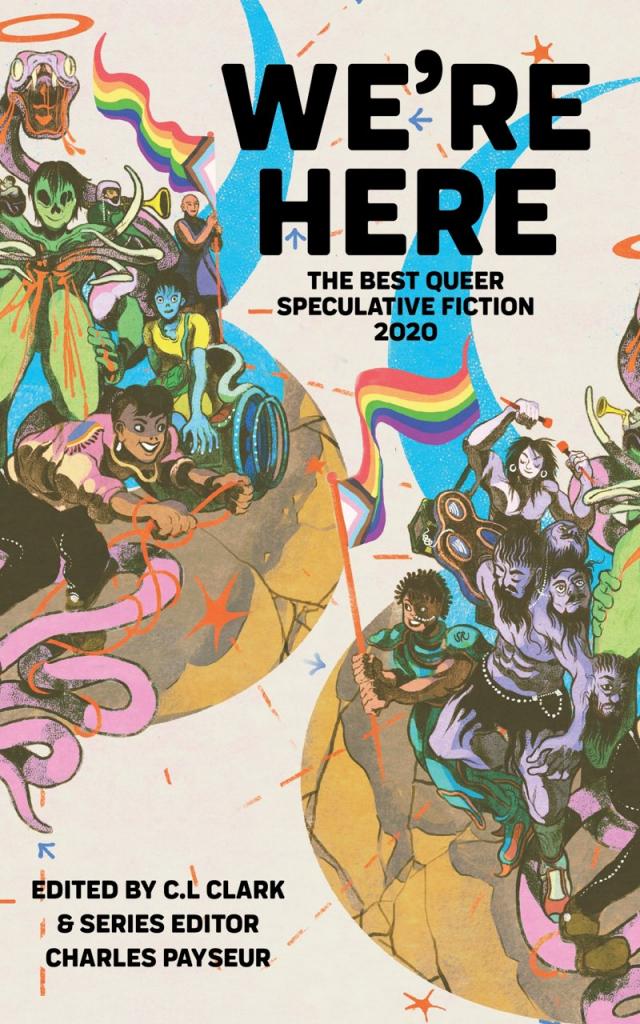
We’re Here
The Best Queer Speculative Fiction 2020
Edited by
C.L. Clark
Series Editor
Charles Payseur
www.neonhemlock.com
@neonhemlock
© 2021 Neon Hemlock Press
* * *
We’re Here: The Best Queer Speculative Fiction 2020
Edited by C.L. Clark and Series Editor Charles Payseur
* * *
All rights reserved. No part of this publication may be reproduced, stored in a retrieval system or transmitted in any form or by any means, electronic, mechanical, photocopying, recording or otherwise without the prior permission of the publisher or in accordance with the provisions of the Copyright, Designs and Patents Act 1988 or under the terms of any licence permitting limited copying issued by the Copyright Licensing Agency.
These stories are works of fiction. Names, characters, places and incidents are the products of the author’s imagination or are used fictitiously. Any resemblance to actual events, locales, organizations or persons, living or dead, is entirely coincidental.
Cover Illustration by Sajan Rai
Cover Design by dave ring
Paperback ISBN-13: 978-1-952086-27-4
Ebook ISBN-13: 978-1-952086-28-1
A Note From the Series Editor
I never imagined I’d be co-editing a Best Of anthology, in part because declaring some group of works the “best” based on editorial preference is...well, not something I’m wholly comfortable with. But since the discontinuation of the Lethe Best Ofs (Wilde Stories, Heiresses of Russ, and Transcendent) that focused on stories with queer content, I’ve been missing the voice they brought to the wider Best Of conversation. And tracking, celebrating, and promoting queer speculative fiction has been something I’ve been engaged with for some time, either passively as a fan of it or actively through my monthly reading lists. So I’m not shy about being involved in the work, and this is perhaps just a continuation of my passions and my pursuits as a reviewer and critic. So here I am, writing this introduction, trying to find things to say about the best queer speculative fiction of the last year.
But that’s not really the start, either. First, I think I have to ask myself, “What is queer speculative fiction?” I feel the need to define terms a bit at least in this first volume because nothing about queerness is simple (except that it’s awesome). When I say queer speculative fiction, I mean work that features queer characters and/or themes. The writers of these works aren’t required to be queer, or to be out as queer. The conversations around that aspect of writing, publishing, and criticism are difficult and nuanced, but for this collection, the criteria is on the queerness of the content. Though...who gets to judge? Certainly if it were just one or two people going around deciding what stories were “queer enough” to consider for this anthology, there’d be a bit of a problem. Thankfully, the best judge of whether a story should or should not be considered is the author of the work, and in that spirit works could be submitted for consideration. It’s not a perfect solution, and I did my best to canvas publications and my own reading for further works to consider as well, but it is, I feel, the best solution available, and I can’t complain about the response we received.
After all, I often find myself a bit frustrated seeing Best Of anthologies where the same few publications seem to feature prominently punctuated by exceptions. Where there’s a general sense that the field isn’t as wide as it is. For queer speculative fiction, this is complicated by what publications put out more or less queer stories, which is by no means equal. It’s also shaped by my own preferences and biases, and those of my co-editor, like any Best Of. All told, I tried my best to look widely, and even so I feel there’s room for improvement, as when compiling the short list I noticed I had multiple stories from Strange Horizons, PodCastle, and The Dark. Which wasn’t bad at all, but I don’t want to fall into a kind of complacency with my reading that might lead me to not consider as closely or enthusiastically works coming from all over. To that end, I’ve already added a lot of publications to what I’m reading in 2021, to go along with what I had already been reading in 2020. Plus, again, the open submissions will hopefully fill in some areas that I cannot, as a single reader, cover.
For this anthology, though, I’ve certainly found that queer SFF is alive and well, and we received close to 300 submissions, which brought the number of stories considered for this anthology probably over 500. And that’s...well, amazing. That’s something to celebrate, even as it’s also something to contextualize before voices from certain quarters begin to claim that publishing queer speculative fiction is easy or advantaged in all levels of the field. After all, a number of the works came from publications that specifically put out queer speculative fiction. Short fiction venues like Glittership, Prismatica, and Baffling Magazine, as well as anthology projects like Silk & Steel, Glitter + Ashes, Decoded Pride, and more, all helped to really boost the numbers of queer speculative fiction being put out. And these represent some incredibly exciting, incredibly good projects that feature some of the most prominent and powerful writers out there. Most of these, though, are projects funded and fueled by small teams and the intense efforts of queer editors and creatives, all happening without an abundance of institutional support.
Not that there’s not reasons to celebrate the queer speculative fiction coming out from larger, more established and more funded publications. Uncanny Magazine, Strange Horizons, the Escape Artist podcasts, and many more short fiction venues have put out a lot of queer stories. As do anthologies from even larger publishers. Queer SFF novellas in particular have had a phenomenal year at presses large and small, with major releases from Tor (like Finna by Nino Cipri), Tachyon (The Four Profound Weaves by R.B. Lemberg), Aqueduct (City of a Thousand Feelings by Anya Johanna DeNiro & more), Neon Hemlock (all four of their novella releases, including the phenomenal Stone & Steel by Eboni Dunbar), Clarkesworld (“Power to Yield” by Bogi Takács), Unnerving Books (Offstage Offerings by Priya Sridhar), and many more. But while queer stories are being published at the largest and most well-known venues, any idea that they are omnipresent or represent anything close to a majority of works published should be quickly dismissed. Rather, these stories and the landscape that allows for their publication exist despite a constant grumbling and prejudice, into whose face we must constantly stand and say “get used to it!”
Still, it breaks my heart that we can’t include all the stories in this anthology, especially because there are some that I dearly loved that didn’t make the cut, either because they weren’t ultimately selected for inclusion or because they weren’t eligible.
Case in point, the work of my co-editor, C.L. Clark, was phenomenal in 2020, and especially the Ignyte Award finalist “You Perfect, Broken Thing” (Uncanny Magazine). It’s one of my favorite stories from last year, but because they are involved with editing this, it wasn’t able to be included. And just because you should read all their stuff, “Forgive Me, My Love, for the Ice and the Sea” from Beneath Ceaseless Skies (which landed on the Locus Recommended Reading List) and “After the Birds and the Bees Have Gone On” from Glitter + Ashes are both also wonderful and feature messy and real and glorious queer relationships.
Though their fiction cannot be included in this year’s We’re Here, I’m honored to be joined by such a sharp and celebrated author and editor. Through their work at PodCastle, Cherae has been recognized with Aurora, Ignyte, and Hugo Award nominations, and last year won, along with the PodCastle team, the British Fantasy Award for Best Audio. As if all that weren’t enough, their recent debut novel, The Unbroken, is a powerful and stunning epic that is also really heckin’ queer.
So it’s a great time to be a reader of queer speculative fiction, even if those lingering conversations about portrayal, audience, and identity aren’t really going anywhere. With the increased marketability of queer SFF, with its increasing prominence in the field, the prospect of curating a Best Of is getting more complicated, more difficult rather than easier. So where does that leave me and this project that you’re holding in your hands (or reading on a screen)? Well...
How I like to think about Best Ofs is that they represent a voice in a conversation. Or voices, as this isn’t a solo venture. Of the editors, speaking from a place of power, yes, with the backing of a publisher. But still just one (or two) perspectives weighing in with joy and with excitement to engage with and celebrate queer speculative fiction. To do the awkward work of breaking the ice, so that what follows can be a conversation between multitudes of people all talking about, all engaging with queer speculative fiction. I’d love to see more people put out lists of their favorite queer speculative fiction. To spread their joy and their love of stories that moved them, that entertained them, that maybe made them feel less alone in a world that for the last year has certainly been isolated and difficult.
And I’ll close with an entreaty. For writers, that if you get a queer SFF story out in the world, let me know. For readers, that if you come across a queer SFF story that you loved, let me know. Either through the open submissions for this project, or through Twitter (@ClowderofTwo) or email (quicksipreviews@gmail.com). I compile these stories into a list every month publicly on my Patreon, and I really just love finding new works of queer speculative fiction.
* * *
Cheers!
* * *
Charles Payseur
May 2021
Eau Claire, WI
A Note from the Guest Editor< br />
It’s spring as I write this from my desk in London. I’m watching the occasional airplane fly by as I contemplate my own impending travel in the coming weeks because of the vagaries and injustices that are borders. It’s strange; the sky used to be more crowded with them. I have lived as an itinerant for the last half-decade, traveling alternately in the footsteps of restless dissatisfaction and urgent curiosity. I find I’m always seeking. Much like in my reading and writing life.
I’ve found in the past few years that there are two main ways to travel. Either you have the means to travel self-sufficiently, with suitcases full of all that you need and the financial means to board in a discrete hotel room, with privacy and a small patch of sovereignty and the ability to keep yourself distant if you so desire. Or, you come with less. You rely on those who greet you when you arrive, who make room for you in their homes, in their communal spaces; you trust that they will share what you could not carry and in return, you give of yourself—your time, your stories, your labor, your care.
Eventually, you leave again—but one of these modes of travel leaves an indelible mark long after you’ve gone.
Perhaps there was something in the water as all of these stories came out, or maybe it was sheer coincidence—but allow me to draw these connections, even if they exist only in my own head. Maybe that’s the truth of the correlation, anyway—I picked them because something in me is obsessed with the idea of movement, especially now that it has been restricted and loaded with danger and consequences in a way that casual travel wasn’t before. But we are barreling through another year of the COVID-19 pandemic, and travel—the notion of it, the idea of free movement, the sharp, frightening and glorious idea of how close we all truly are to each other—it’s been forever changed. And I think that most of the stories I’ve chosen for this anthology reflect this in some way or another, for all that they deal with speculative worlds.
More than a few aptly speculate on the distances that separate us as global catastrophe changes the very landscapes we traverse, like Waverly SM’s flooded England in “The Last Good Time to Be Alive,” where everyone outside of central London risks starvation as their homes are swallowed up, calling to mind the way the global north will weather climate change. Another is Brenden Williams-Childs “The Wedding after the Bomb,” where our narrator hikes through the burnout zone of a nuclear bomb, all to attend the wedding of two people they’re not sure are still alive.
In fact, there’s a line in Childs’ story that echoes a theme of travel that I love: “You won’t be the same person you were when you went into [the woods]. This is true about everywhere you go.” You may leave a mark on a place, but it will always leave its mark on you, whether you realize it or not—but it will change you the most if you’re open to the transformation. It is a story many queer people know well, as we go on long journeys to transform ourselves and be perceived truly. Many of the stories in this anthology show this transformation literally, including Charlie Jane Anderson’s “If You Take My Meaning,” where revolutionaries journey into the depths of a mountain to become hybrid beings that just might save humanity, and “Rat and Finch Are Friends,” where two boys who can turn into animals find themselves crossing a chasm that is wider than them realize, and with painful consequences. And there is Anya Johanna DeNiro’s “A Voyage to Queensthroat,” where, through pilgrimage and devotion, a child can become the woman she was meant to be.
For others, travel is about seeking answers, seeking comfort, seeking truth or love—seeking the self. And these also are journeys queer people often take out of necessity, and they are worth taking even if, on the outside, you remain exactly as you are, because on the inside the trials and discoveries have made you into something stronger, sturdier, maybe even whole. A few stories in this vein include “Salt and Iron” by Gem Isherwood, where a woman cursed with iron fists and a blind woman fight in their own ways against a world that would have them kneel to others and “To Balance the Weight of Khalem,” which...well, it truly defies description, but you will follow a scholar on their own journey through space and memory as delicate as the crinkled husk of an onion.
There are stories of escape. The flight of the refugee, the persecuted. Stories of entrapment, so that the only journeys you can take are in your imagination. Those, too, are stories that queer people know too well. There are even stories in the form of that oh-so-familiar quest, video games and super heroes, all queered.
In all of these journeys, it is love that carries the characters from one point of the journey to the end (do these journeys ever truly end?): love for their partners, love for their community, their family, even love for themselves, which is often the hardest love to give. It’s the glue that will hold us together.
It would be easy in a time like this—in fact, it has been recommended—to close down, stay put, and seal ourselves off from others. It’s safest. It protects us. But it will also damn us, if we are too locked within our strongholds to reach out to one another. And there are ways, healthy, safe ways, to keep ourselves open and available to make gifts out of each others’ presences and resources, digital or otherwise.
As a people, humanity has a great capacity for generosity, a tensile strength that can hold together under the strongest beatings; marginalized people in particular know this well. More often than not, we have been all that we had, and so we cling to that.
But that generosity doesn’t have to stay within the margins.
Reach out. Come with me.
The only way we’ll get where we’re going is together.
* * *
C.L. Clark
May 2021
London, England
Contents
Escaping Dr. Markoff
Gabriela Santiago
The Currant Dumas
L.D. Lewis
The Ashes of Vivian Firestrike
Kristen Koopman
Portrait of Three Women with an Owl
Gwen C. Katz
If You Take My Meaning
Charlie Jane Anders
Voyage to Queensthroat
Anya Johanna Deniro
Body, Remember
Nicasio Andres Reed
Rat and Finch Are Friends
Innocent Chizaram Ilo
The Last Good Time to Be Alive
by Waverly SM
Everquest
Naomi Kanakia
8-Bit Free Will
John Wiswell
The Wedding After the Bomb
Brendan Williams-Childs
Thin Red Jellies
Lina Rather
Salt and Iron
Gem Isherwood
Monsters Never Leave You
Carlie St. George
To Balance the Weight of Khalem
R.B. Lemberg
About the Authors
About the Editors
About the Press
Escaping Dr. Markoff
Gabriela Santiago
You love Dr. Markoff.
You have always loved Dr. Markoff, even before the film began.
He is unlike any man you have ever met. Have you met many other men? It is so difficult to remember. His hair is black as jet. His eyes are as deep as night. When he speaks in his low accented voice you hear red wine being poured slowly into a crystal glass.
“You are only my assistant,” he says. He is a mountain in winter. “Never forget that.”
Rewind to the beginning of the scene. He has taken you to the symphony, an exclusive concert by The Father, an acclaimed violinist. You are in the box next to The Beautiful Daughter and The Fiancé. The Beautiful Daughter and The Fiancé are so pale they blaze with light, threatening to chase away all shadows and contrast.