Worlds revolution 01 g.., p.1
World's Revolution 01 - Gaia Awakens, page 1
part #1 of The World's Revolution Series
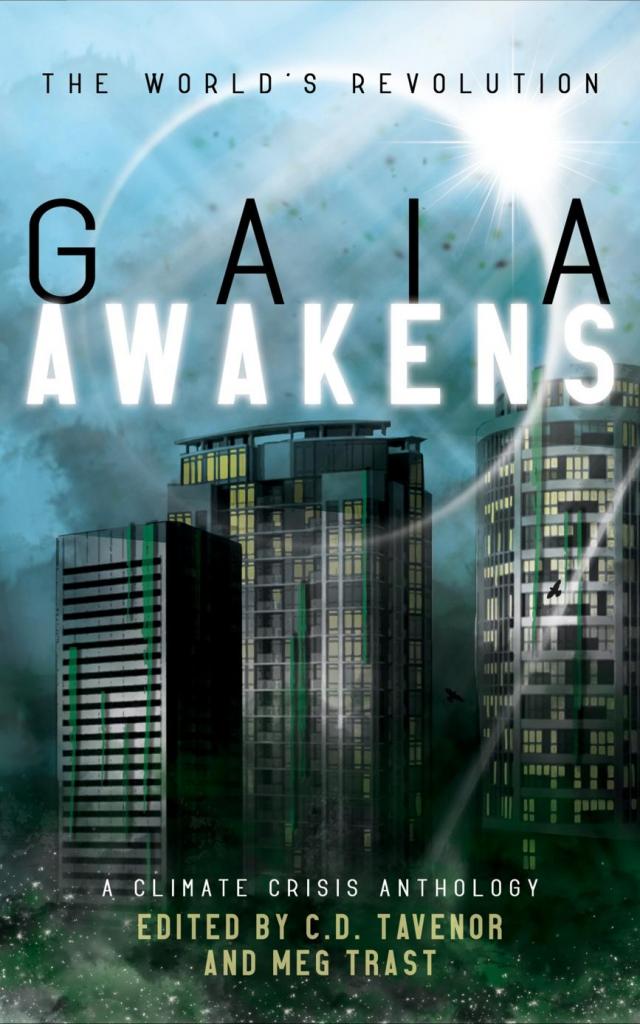


Gaia Awakens
A Climate Crisis Anthology
Book I of The World’s Revolution
We hope you enjoy Gaia Awakens: A Climate Crisis Anthology. If you like the first book of The World’s Revolution, consider following the project on social media:
Facebook: The World’s Revolution
Twitter: @TheWorldRevolts
___________________________
Published by Two Doctors Media Collaborative LLC
www.twodoctorsmedia.com
Cover design by S.E. MacCready
https://semaccready.com/
© 2021 Two Doctors Media Collaborative LLC
All rights reserved. No portion of this book may be reproduced in any form without permission from the publisher, except as permitted by U.S. copyright law.
This is a work of fiction. Names, characters, businesses, places, events, locales, and incidents are either the products of the author's imagination or used in a fictitious manner. Any resemblance to actual persons, living or dead, or actual events is purely coincidental.
ISBN: 978-1-952706-29-5 (Paperback)
ISBN: 978-1-952706-30-1 (e-book)
ISBN: 978-1-952706-31-8 (hardcover)
Table of Contents
Editor’s Note
The Gaia Stones
Catalyst
The Spin
The Green Ceiling
Behind the Mirror
The Bent Greens
Two More Days to Sydney
Ring of Contamination
Garden of Eden
The Lifespan of Wildflowers
Real-Time
Culling Day
The Crystal Haze
Gaia’s Final Embrace
Talking Trees and the Heavy Metal Moose
Enhanced Weathering
SOOT SHIELD
Scourge of the Mosquitoes
Translocation
Team Wolf Anxiety
The Coast Guard
The Quiet Ghost of Willow Way
Gaia Awakened
About The Authors
Join The World’s Revolution!
Editor’s Note
Welcome to Gaia Awakens: A Climate Crisis Anthology. It is the first book in the collaborative universe known as The World’s Revolution. We’re excited you’re joining us on this adventurous experiment in climate fiction storytelling.
The World’s Revolution began as a simple concept discussed between a few authors. What would it look like to create an anthology where every story occurred in the same setting? How would you properly connect the narratives without everything feeling disjointed? More importantly, around what concepts should the narrative center?
While the answers to most of the questions resolved themselves over time, the need to focus the collection on the climate crisis became immediately apparent. I’ve wanted to dive deeply into the world of climate fiction for quite some time, having merely dabbled in previous stories I’ve written or books I’ve edited for other authors. An anthology focused exclusively on climate fiction both felt like a perfect opportunity to develop the collaborative universe and encourage storytelling about a topic of utmost importance.
A climate fiction anthology, with stories written by authors from across the world, from many different perspectives, ideologies, and experiences, presents a wonderful opportunity to explore those questions.
We need stories to inspire hope. Inspire change. Inspire revolution.
But “revolution” and “change” and “hope” mean a lot of different things to a lot of different people.
So we brainstormed. We developed the initial concept of The World’s Revolution back in 2020, even before the COVID-19 pandemic began. We workshopped the branding for the project, created a Kickstarter campaign, and successfully funded it. We launched our call for submissions in March 2021, received excellent fantasy and sci-fi stories over the span of three months, and now we’re here, releasing the first anthology.
It will hopefully be the first of many.
But as I write this note, the Intergovernmental Panel on Climate Change’s (IPCC) most recent climate report is hot off the press. It’s nearly certain that we’ll reach 1.5 degrees Celsius during this century, and it’s very likely we will far surpass that temperature. We are standing on the precipice of the climate crisis, with very few “good” options awaiting us in the future.
It’s made these stories feel all the more important. And tiny, in the face of the true complexity of the threat we face.
Our final anthology features stories written by authors on four different continents and with a wide variety of backgrounds. Some stories address the question of climate change from a fundamentally human angle, or a technological approach, or a spiritual perspective. Some of the stories are wonderfully weird or action-packed, while others are melancholy. Thought-provoking. Reflective.
I’m proud of the authors who took a chance on this project and wrote stories for it. It’s been a pleasure working with them, refining their narratives, and ensuring every tale fits within the collaborative universe. What surprised me the most was how many of the stories felt connected even before I made a single suggestion. The authors featured in this collection did their homework and read the worldbuilding we established as part of the call for submissions.
Still, there are many stories missing. The collection features the work of sixteen talented authors through twenty-three stories, but that’s only sixteen perspectives on the climate crisis. Only sixteen voices coming together to write stories about the World’s Revolution, a narrative that requires millions of voices to truly encompass the human experience of our rapidly transforming planet.
If you’re an author reading this collection, I encourage you to consider what tale you would write.
Inside Gaia Awakens: A Climate Crisis Anthology, you’ll notice connecting themes and characters. The story begins in 2040 C.E. and ends in 2055 C.E., and overtime, a full picture of The World’s Revolution will emerge. The authors of these stories have taken the concept presented to them by storm and made it their own.
I am honored to have the opportunity to act as the facilitator for their stories to reach the minds of readers.
At the end of the anthology, you’ll find more information about each author. I encourage you to take a look at the works they’ve published elsewhere. If we’re to tell more climate fiction stories, we need to support climate fiction writers, after all!
Similarly, I hope you’ll stay in touch with The World’s Revolution and prepare yourself for future collections. I’m excited to see what authors propose for our next anthology. And we’re not restricted to short stories. I envision a future where authors can write novellas and novels and series under The World’s Revolution banner, too.
The sky is the limit.
However, I’m not going to pretend like this one anthology is the solution to all of our problems. Telling stories inspired by the climate crisis means nothing if the inspired thoughts don’t turn into action. Take what you learn from these narratives and find a way to make a difference in your community.
Find an organization to join that furthers the call for justice in your world. Organize your neighborhood to develop sustainable projects and programs. Talk to your friends and family about what we need to do to transform the world so future generations can thrive upon its surface.
Read these stories. Let them entertain you and inspire you. Then do something in response.
Because the world described in the pages that follow isn’t a world we should want to come to pass. In the present, we still have a chance to stop the worst impacts of climate change.
In Gaia Awakens, the world is nearly past the point of no return. By the end of the anthology, it’ll be up to you to decide whether hope remains for our heroes.
In solidarity in the fight against the climate crisis,
C. D. Tavenor, Editor for The World’s Revolution
______
THE END IS NIGH!
So, what can I do about it? I don’t have influence. I don’t have money, or resources. I’m trying to survive daily life.
Most of Us
At the end of the day, your resources will always include yourself. Your voice. Your thoughts, your insight, your ingenuity. Sixteen incredibly talented authors came together over the past year to put their thoughts into words, to share the real story of what the climate crisis could mean if we don’t turn it around and make a better world for our progeny. Most individuals do not have the platform or resources to initiate the type of big change our planet so desperately needs. But when our voices unite, they become thunderous, unignorable. You may feel like a drop in the bucket, but enough single drops will eventually overflow.
That’s what we hope Gaia Awakens is: the first few drops in a huge bucket we call Earth.
In solidarity in the fight against the climate crisis,
Meg Trast, Co-Editor for The World’s Revolution
Acknowledgments
S.E. MacCready, A.E. Faulkner, and Kit Hanson all deserve a special recognition for their work on this project in both seen and unseen ways. They are an incredible team, and this project wouldn’t exist without them.
Likewise, it’s absolutely essential that we thank all of our Kickstarter backers who made this project possible. Every one of them contributed to the creation of this project, enabling us to pay authors immediately for the stories in the anthology. In particular, we would like to
Julie Fillius Thomas, Alana Powell, John Winkelman
Shaun Olmsted, The Maggios, Scott Mattocks
Carla Severe, Dale and Sue O’Donnell, William Clemens
Susan Hutcheson, Trevor Britton, Susan and Tom Tavenor
Ganesh M. Nair, Ashley Welsh, Brian Timm
Christian Meyer, Noah Taylor, D Jole
Now, without any further delay, please enjoy the stories of Gaia Awakens: A Climate Crisis Anthology, Book 1 of The World’s Revolution.
The Gaia Stones
David Kernot
2040 C.E.
Mike Ironbark drove the shovel into the hard dry ground. He glanced at the year-old oak seedling in the pot nearby and wondered how many years it would take for the tree to shade the farmhouse. “This is for you, Dad,” he said.
Dad had believed everything was connected, and he died twelve months to the day. The family had potted the acorn that night in his memory. Today, they’d plant the seedling in the ground and celebrate his life again.
Mike’s arms and shoulders ached from the compacted soil. He blamed the early onset of summer. What, with the ongoing pandemic, climate change, and the looming global water shortages, he was happy the loose confederation of pacific island states, along with New Zealand and Australia, had formed the Oceania Alliance. As a small and isolated political bloc, it had been easy to mostly close their borders to the rest of the world.
He stood, straightened his tight back muscles, and removed his worn wide-brimmed hat. He wiped the sweat off his brow and stared at the small rise of hills in the distance. They marked the edge of the farm and had already turned a deep shade of rusty-brown. In front of them, the heat shimmered above the expanse of wheat. How could it be so hot in the morning?
“Curse this heat,” he said, and looked around for his crowbar. He stared up at the cloudless, indigo-blue sky, proud of his successes on the land. This was Dad’s farm, his legacy.
He turned at the sound of the back screen door spring stretching. Anna, his wife, stood by the door of their farmhouse, a towel wrapped around her slender body and her long wet hair stuck to her. Mike couldn’t help but smile. She looked beautiful, and he was the luckiest man alive.
“Mike, there’s no water for Maisie Jane’s shower,” she said.
“Have you checked the tank?”
“Yes, it’s dry.”
Mike’s heart skipped a beat, and he frowned. Out here, water was their livelihood. Without it, everything would die. The crops, the animals . . . the people. Showers were the least of his concern. But it was odd. The bore pump should have automatically filled the house tank overnight. The breaker had probably tripped; it had done that a few times of late. Salt or contaminants lodged in the pipes stretching deep underground. He sighed. And spoke out loud in a rebellious fashion—but not loud enough for Anna to hear him. “Australia’s Great Artesian Basin.” Why they had renamed the Australian continent South-West Pangaea, part of the greater Oceania Alliance, was beyond him. Australia would always be Australia, even if the world continued to create new, locked-down alliances and isolate people, even if it was probably the only way to end the wars over water and food and maintain disease-free regions after endless years of pandemic.
“Have we got power in the house?”
She nodded.
“Ok, I’ll go check.”
“Daddy, Daddy.” The outside screen door opened wider. Their daughter, Maisie Jane, ran around Anna and made a beeline toward him. He smiled and squatted down. She threw herself into his arms. Maisie Jane was the spitting image of Anna, except she was tall and her eyes a deeper blue—something she’d inherited from him.
Maisie Jane still looked too pale and thin, but the doctors had said her leukemia was in remission. He hoped so.
“Sleep well, Mouse?” He ruffled her uncombed hair.
The six-year-old nodded. Maisie Jane looked around him, to the small hole in the ground, at his shovel, and the oak tree. “Grandpa’s tree,” she said.
His throat tightened, and he swallowed several times to work it away before speaking. They’d made many promises on Dad’s deathbed, but it had been at Maisie Jane’s insistence that they planted an acorn in his memory.
It didn’t seem a year ago that his father had leaned forward and put his paper-thin hand on Maisie Jane’s cheek. “Mouse,” he said. “You can tell your grandchildren it was Grandpa’s tree because he loved you so much.” She nodded. “And by that time me and the tree will be one with Mother Gaia, then you’ll have the magic Gaia Stones I gave to your dad.”
Dad had chuckled and made one last joke. He passed shortly after, his hand on Maisie Jane’s arm.
Mike’s throat tightened again. Dad had always been bigger than life, and he hoped he’d be the same for Maisie Jane. His hands went to the chain around his neck, to where the three small emeralds were cocooned in silk and their separate hessian bags. The Gaia Stones, Dad had called them. Even now, they glowed hot, as if they had lives of their own. They seemed to call to him. Unfamiliar images formed at the edge of his vision, and—
“Don’t cry, Daddy.”
Mike pulled himself from his memories, forcing the stone’s images aside. They could wait for another time. He wiped away the tears he’d been unaware of until Maisie Jane spoke, and he ruffled her hair again. He didn’t trust his voice not to be twisted with emotion as he nodded.
“Maisie, come inside and let Daddy check the pump.”
Maisie Jane leaned closer. “Remember?”
He nodded again and swallowed. “If I see any, I’ll let you know.”
“But don’t hurt them,” she said quickly and held up a tiny index finger determinedly that reinforced the impression she was such an old soul. She seemed years older.
“I won’t.” He stood and watched the young girl run back inside. He smiled and shook his head. There was so much of his mum in her. It was uncanny. He regretted that Mum and Anna had never met, but Mum had passed years before from the cancer. Maisie’s obsession with dragonflies always amused him, and especially Dad, who had given Maisie Jane his wife’s anniversary gift of an intricate, gilded dragonfly. But Maisie Jane was right. They darted around near the small bore pump shed in search of water. They might even be at the header tank, hovering over a broken pipe that fed the farmhouse.
* * *
Mike stood at the empty water tank, and a sense of urgency gripped him. It clawed at his chest like a wildcat intent on ripping him apart. The stones at his throat seemed to lick him with fire, and he swallowed hard. He pushed away an image of vivid, lush green pastures with their horses frolicking across the paddocks and stared at the harsh, dry hillside. Far to his left, a flock of his sheep gathered near a clump of trees. The horses in the stables kicked at their pens and whinnied for food.
A dragonfly appeared. It moved straight up above him, flew backward, stopped and hovered a short distance away, almost as if it waited for Mike to do something. But he couldn’t. The dragonflies would die soon as the remaining water vanished.
He had a bad feeling. Water was everything, and he didn’t have the money to truck in supplies. Not this year. His two thousand acres of land were worthless if he didn’t have water to last the dry summer. He took a breath, slow and deliberate. Worrying too much, as always, never helped. He had water. Everything would be fine. He strode down the hill to the pump shed, convinced the breaker had tripped again. Maisie Jane’s shower would follow. Anna could wash the soap from her hair.
Mike’s phone in his pocket buzzed. He stopped in the shade of a tree and answered the call. “Hello?”
“Hey big brother, happy 2040, how are you?”
He grinned. “Rashi, how have you been?”
“Good. I wanted to call and see how you are. Dad would have wanted that.”
He nodded in agreement. “We planted a tree for him today.”
“Lovely.”
He rubbed the side of his neck and turned his back to the burning sun. “What’s it like in the Texan Alliance of States? Are you going to return home soon?”