Lauras shadow, p.1
Laura's Shadow, page 1


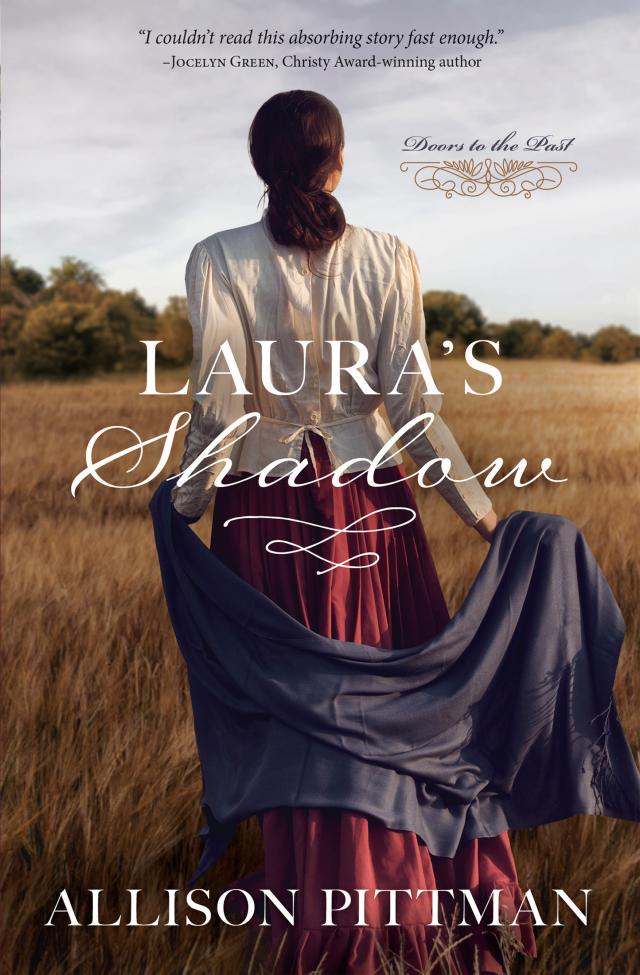
Praise for Laura’s Shadow
“Allison Pittman is one of those rare authors who shines with equal brilliance no matter the time period she writes. Laura’s Shadow is the perfect showcase for the gritty nineteenth-century historical on the South Dakota prairie, and the 1970s Twin Cities tale of an utterly lovable newspaper cartoonist on a quest to unlock her great-grandmother’s secrets. Pittman breathes life and love, hope and heartache into a minor character first penned by Laura Ingalls Wilder, and then surrounds her with her own world, complete with generations to round her out. I couldn’t read this absorbing story fast enough.”
– Jocelyn Green, Christy Award-winning author of Drawn by the Current
“It’s a daring endeavor to take even a tangential run at another author’s famous characters, but rest assured, Dear Reader, the world of our beloved Laura Ingalls Wilder is in more than capable hands in Laura’s Shadow. Pittman weaves a wonderful dual timeline story showing how the past reaches out to the present, and how ‘no man is truly free in whom a thousand ancestors ride.’”
– Erica Vetsch, author of The Thorndike & Swann Regency Mysteries
“Laura’s Shadow is an expertly layered book about generational patterns and stories woven from love and loss. Readers will fall in love with the Gowan women—earnest Trixie, an artist pursuing a career in 1974, and her great-grandmother Mariah who comes of age in late 19th century South Dakota. Both eras are vividly painted and every scene engrossing. It was a challenge to put the book down at bedtime (so I just didn’t.) Another gorgeous novel that serves to further Allison Pittman’s reputation as a uniquely gifted author.”
– Kimberly Duffy, author of A Tapestry of Light
“Pittman’s novels have the ability to immerse and transport readers to the past, and her latest, Laura’s Shadow, is no exception. Rich prose, lush descriptions, and astute characterizations combine to weave a story wrought from minor characters in Laura Ingalls Wilder’s beloved books, as well as a more modern counterpart. A nostalgic tale told with heart and insight.”
– Anna Lee Huber, USA Today bestselling author
“Allison Pittman has crafted a stunning book of two women, three generations apart, deftly weaving their stories into an unputdownable tale. Pittman writes gorgeous prose that tugs at the heart even as it fills the reader with hope. This is a book not only for fans of Little House on the Prairie but for anyone who enjoys a captivating story. I loved it!”
– Liz Johnson, bestselling author of The Red Door Inn and Beyond the Tides
Laura’s Shadow © 2022 by Allison Pittman
Print ISBN 978-1-63609-350-5
Adobe Digital Edition (.epub) 978-1-63609-351-2
All rights reserved. No part of this publication may be reproduced or transmitted in any form or by any means without written permission of the publisher. Reproduced text may not be used on the World Wide Web.
All scripture quotations, unless otherwise noted, are taken from the King James Version of the Bible.
This book is a work of fiction. Names, characters, places, and incidents are either products of the author’s imagination or used fictitiously. Any similarity to actual people, organizations, and/or events is purely coincidental.
Cover Photograph: Magdalena Russocka, Trevillion Images
Published by Barbour Publishing, Inc., 1810 Barbour Drive, Uhrichsville, Ohio 44683, www.barbourbooks.com
See the series lineup and get bonus content at DoorsToThePastSeries.com
Our mission is to inspire the world with the life-changing message of the Bible.
Printed in the United States of America
A NOTE FROM THE AUTHOR
I don’t remember the first time I read Little House on the Prairie, but I have no strong memory of a reading life that doesn’t include the Laura Ingalls Wilder books. When I was in third grade, I wrote a letter to Mrs. Watson, our librarian, complaining that they were housed in the Fiction section when, really, shouldn’t they be in Biography? She explained, gently, that there was a difference between the two: She said that biography was the story of a person’s life and that what Laura Ingalls Wilder did was to put her life into a story.
Over the years, as my interest in Laura Ingalls Wilder grew and matured, I learned that, of course, details were changed, personages recast and reimagined, timelines resequenced. I cannot recommend highly enough the Pioneer Girl: The Annotated Autobiography (edited by Pamela Smith Hill) and the Pulitzer Prize–winning Prairie Fires: The American Dreams of Laura Ingalls Wilder by Caroline Fraser for a more in-depth look not only into the life of the Ingalls family but a look at their life in the context of American history.
All that said, this novel, dear readers, is a pure work of fiction, woven completely from my imagination, inspired by my lifelong crush on Cap Garland, a minor character in the latter novels of the Little House series. The sole bits of truth: Laura Ingalls was a teacher for a small school (five students) for a brief moment in time. Two of those students were a brother and sister—Charles and Martha (or Marthe, as Wilder spells it in Pioneer Girl)—whom I have conscripted for this story, renaming the girl once more—Mariah. The prologue of this novel retells a scene from Wilder’s These Happy Golden Years from Mariah’s point of view. And while I stayed true to the bullet points of Cap Garland’s life and death, every word about Mariah and their paths crossing is just my writer’s imagination run wild.
My fellow Little House fans will, I hope, run wild with me.
Allison Pittman
Table of Contents
Prologue
Chapter 1
Chapter 2
Chapter 3
Chapter 4
Chapter 5
Chapter 6
Chapter 7
Chapter 8
Chapter 9
Chapter 10
Chapter 11
Chapter 12
Chapter 13
Chapter 14
Chapter 15
Epilogue
PROLOGUE
The schoolhouse was nothing more than a shack, with sunlight and drifting snow blowing through the spaces between the thin, rough-cut slats. The previous owner, terrified of winter on the South Dakota prairie, had hightailed it back east until spring. Mr. Bouchie had taken it upon himself to make four desks out of scrap lumber, paint a black square on one wall, and bring in a fine table with spooled legs for the front of the room.
It took a moment for Mariah Patterson’s eyes to adjust to the dimness after walking a mile squinting against the morning sun. Once they did, she turned to her brother, Charles. “Looks like we’re the first ones here.”
“Yup.” It was Charles’s favorite word, and without another, he took a long match from the box on the wall behind the small stove in the corner, lit it, and dropped it in. Their pa had come home from the school board meeting (meaning, coffee at Mr. Bouchie’s place) declaring that the first students to arrive at the school were responsible for lighting the fire, and the teacher would lay it ready for the next day. This morning Pa had prodded Mariah and Charles out the door, fearful they might be tardy but also wanting them to be early enough to take on this honor and to welcome the young woman who would be their teacher for the short winter term.
Mariah felt no compulsion to remove her coat and hat while she waited for the first tendrils of warmth to enter the room, but she did unwind her muffler and discard her gloves, stretching her hands toward the little stove in anticipation. Any worries about puddles forming as the snow melted from her skirt disappeared along with the tiny streams that ran into the cracks in the floor. Her cheeks were just beginning to thaw when the room filled with light as the door opened and three more students came in.
“I’ll beat you here tomorrow.” The boy who issued the challenge had the stature and voice of a full-grown man. Clarence, she remembered. Clarence Bouchie, son of Mr. Bouchie, the self-appointed superintendent. At seventeen, he was the oldest student, followed by Charles, sixteen, and Mariah, fourteen. “I would have today, but I had to cut a path for the little ones.”
The little ones were hardly more than two mobile mounds of wool, but with each layer peeled off in the warming room, she saw a little boy, Tommy, and a tiny girl, Ruby. They’d all met once, gathered in Mr. and Mrs. Bouchie’s parlor—the same meeting in which all the rules and procedures for the school had been set. Mariah remembered Mrs. Bouchie saying, “Please, come sit in the parlor,” as if it were something more than a bare room with a single sofa and the table that now sat in the front waiting for the teacher.
“You don’t think we might be a little too old for school?” Mariah asked. Besides being close in age to Clarence and Charles, she was nearly as tall and felt like a giant next to the younger Bouchie children.
“Maybe,” Clarence said. He had a mop of unruly dark curls that poked out from the fringes of his cap. He took it off and combed them back, revealing dark brows that seemed to dance as he spoke. “But sitting around in a dark cabin is the same whether at home or here, and at least at school there’s a chance to look at a pretty girl.”
Mariah felt a blush rising but cooled when Clarence elbowed Charles in the ribs and said, “I hear the teacher’s not but sixteen.”
“And how do you know she’s pretty?” Mariah asked.
Clarence shrugged. “I don’t know that she’s not.”
Warm now, Mariah took off her coat and left the tight circle to hang it on one of the hooks beside the door. She herself, she knew, would never be pretty enough to prompt a young man to leave his home to spen d a day looking at her. She needed no looking glass to affirm this; she need only look at Charles’s face to see her own—long, drawn, with a thin nose that had an incongruous bulbous tip, and wide green eyes dusted with sandy-brown lashes. Unlike Clarence’s, Charles’s hair was straight and fine, and—as in all other features—Mariah’s was the same. But Charles had the enviable advantage of wearing his clipped short, while Mariah was forced by some unspoken mandate to wear hers long, even though the silky texture of it defied any attempt at pinning or curling. For her whole life, or at least since the loss of their mother when Mariah was eight years old, she’d worn her hair in one plait down the center of her back, tied at the end with a scrap of ribbon. Or string, or twine—whatever came closest to hand. Little Ruby had the same thick, dark curls as her oldest brother; Tommy was a towhead blond. But then, the Bouchie family was a mishmash of siblings and half siblings and stepsiblings acquired through a series of marriages and death. (This too she learned at the meeting in the parlor where she sat on the floor with a cup of warm, weak tea and a gingerbread cookie.) She envied the chaos of their household, on full display that evening. The Patterson household consisted of only her father, her brother, and herself, with no one inclined to conversation. In fact, most evenings meant a collective sigh of relief when the sun dipped low enough to send them to their narrow beds.
The schoolhouse door opened one last time, bringing a whoosh of cold air into the now cozy room, and suddenly the students’ silence seemed less comfortable with the arrival of their teacher.
Mariah’s first thought was that the woman was small. Not merely short but diminutive. Taller than Tommy, but then he was a little boy. Her little feet barely made a sound as she walked across the room, and as she approached—drawn by the heat of the stove—she unbuttoned her coat to reveal a figure even tinier than Mariah had speculated.
Nobody spoke, not until Teacher said, “My, it is cold, isn’t it?” And they murmured in unison agreement that yes, it was. And then the silence fell again while the clock on the front table ticked out five more minutes before Teacher instructed them all to take their seats.
Class was about to begin.
Clarence volunteered to take the last seat in the room, which made sense because he was the oldest and biggest, but that also meant he would be farthest away from the warmth of the stove. The closest would be Ruby, in the front, then Tommy, then Charles and Mariah who would share a seat because they would also have to share a textbook. And a slate.
When Teacher inquired as to what level reader she and Charles shared, Mariah answered, “McGuffey’s Third,” and tried not to flinch at the teacher’s facial expression in response. Was it pity? Disdain? She may as well have tsked and said, Poor prairie children. Barely literate, and here I am their age and already teaching. What Mariah didn’t tell her was that the reader had been their mother’s last purchase before succumbing to the illness that took her spirit long before it took her life, or that Mariah had devoured the book within days, reading the passages aloud at her mother’s bedside, or that Mariah had taken it upon herself to coach her older brother through page after torturous page. She also didn’t mention that she owned three novels herself: Around the World in Eighty Days, Through the Looking Glass, and The Adventures of Tom Sawyer, each of which she had read a dozen times, portioning out the pages by candlelight in her room. Maybe if she had, things would have been different between Mariah and the teacher. They might have become friends, staying inside while the big boys and the little children played at recess, talking about books and literature and favorite authors. But to do so would leave Charles behind, struggling to recall even the most basic details from the simplest stories. Not that Charles was stupid—far from it. There wasn’t a piece of machinery he couldn’t repair or build outright if given the materials and time. He could measure and calculate with unwritten precision; his hands were never idle, but they were never meant to hold a book. They hadn’t been to a school for more than two consecutive terms since Mama died, always moving to board with one relative after another until Papa built this claim. At each school, when asked about their reading, Mariah answered, “McGuffey’s Third,” and they started on page one.
The first day passed pleasantly enough, as did the first week, though Teacher gave Mariah and Charles a tardy demerit when they were five minutes late arriving that Wednesday morning.
Never mind that we had to break a path for over a mile in two feet of new snow, Mariah thought, hoping the flush she felt on her cheeks would be mistaken for the cold.
“It is important to cultivate good habits,” Teacher said, and Mariah noticed her tiny feet barely reached the floor beneath her chair, “and factor in unforeseen circumstances.”
“We will try to do better next time,” Mariah said. Charles was already in their seat, eyes downcast to the desk. His coat hung on the hook, but Mariah kept hers on not only because she could still feel the cold in her bones but she didn’t want to take any more time settling into their lesson. Clarence had been smirking since they walked through the door, and he continued to do so as she walked to her place. When she sat down, he leaned forward, close enough that she brushed her glove against his face as she unwound her muffler.
“Teacher herself only got here ten minutes ago,” he whispered. “Don’t let her shame you like that.”
“I’m not ashamed,” Mariah whispered. “I’m determined.”
Teacher rapped her knuckles on the table and called for silence, saying that quite enough time had been wasted that morning, and they should conserve their speech for recitations.
The morning passed slowly, and only the boys chose to go outside to play in the snow after eating their dinner. Teacher pulled a chair up to sit with Mariah and little Ruby, and as they finished their bread and butter with bits of pleasant conversation, Mariah took a piece of molasses cake from her tin and broke it into thirds, offering to share it all around. Ruby took hers and chomped into it immediately, heedless of the crumbs that gathered in the corners of her mouth.
“When I was a little girl,” Teacher said after taking a single small nibble, “my pa would bring sticks of candy home from the store when he went into town. I would eat mine all at once, but my sister could make hers last for days. I would be so envious, almost like she had more than I did because it lasted longer. I used to beg Ma and Pa to make her share with me.”
“Charles is the same,” Mariah said, nibbling too. “Well, not exactly the same. He doesn’t care for sweets, so I usually end up eating his share.” She thought about the precious bits of sugar and eggs she’d used to make this treat. “I put a piece in his lunch pail, and I’ll bet you nine buttons it’s in there still and he’ll offer it to me on our walk home.”
“Charles. That’s my father’s name.” The teacher smiled, giving Mariah a peek into the girl she might be if her hair wasn’t pinned in a fancy twist, or if she didn’t have to ensure they all mastered their arithmetic in the afternoon. She seemed softer after that, to the point of joining in a snowball fight to even up the sides—boys against girls. When Clarence hit her square in the face, she laughed, even as the boy held her steady to wipe the snow out of her eyes with the end of her scarf. Teacher laughed in the moment, but afterward redoubled her effort to maintain discipline and control, especially in regard to Clarence. He was, after all, taller, older, and—Mariah guessed—probably smarter than she. Often, when Clarence would misspell a word or come to the wrong answer on a mathematics problem, Mariah suspected he was fooling them all, not wanting to show off. It was as if there was a taut, thin wire strung between Clarence and the teacher—a tension ready to snap at any moment.
When Friday afternoon of the first week of school arrived, the well of patience and good behavior seemed to have run dry. Clarence was unbearable in his restlessness, constantly flicking Mariah’s braid and baiting Charles to misbehave. Tommy knew none of his lessons and had to be reprimanded for lack of applying himself, and even sweet little Ruby whined against instruction. The fire burned low in the stove, bringing the temperature of the room down with it, and nothing in any of the books—not the readers, not the math, not even the Bible—could have enticed anyone into the spirit of learning. Even the teacher’s sharp reprimands were incomplete and distracted.