

The long corner, p.1
The Long Corner, page 1


ALSO BY
ALEXANDER MAKSIK
You Deserve Nothing
A Marker to Measure Drift
Shelter in Place
Europa Editions
27 Union Square West, Suite 302
New York NY 10003
info@europaeditions.com
www.europaeditions.com
This book is a work of fiction. Any references to historical events, real people, or real locales are used fictitiously.
Copyright © 2022 by Alexander Maksik
First publication 2022 by Europa Editions
All rights reserved, including the right of reproduction in whole or in part in any form.
Art direction by Emanuele Ragnisco
instagram.com/emanueleragnisco
Cover design by Ginevra Rapisardi
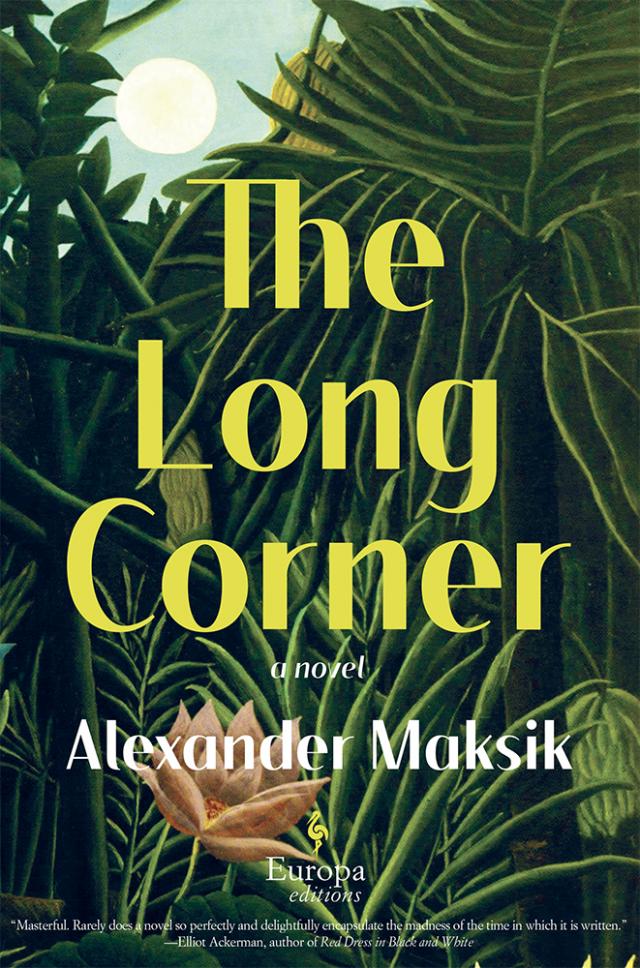
Cover image: The Dream by Henri Rousseau 1910
(detail) / FineArt Alamy Stock Photo
ISBN 9781609457525
Alexander Maksik
THE LONG CORNER
THE LONG CORNER
For Ela, may you always know the difference.
PART ONE
The art of any period tends to serve the ideological interests of the ruling class.
—JOHN BERGER, Ways of Seeing
1
Not long after Donald John Trump was elected president of the United States of America and all the fires he lit were just beginning to burn, Charity Joy Strickler dragged me to yet another concrete-floored room where I was expected to conduct myself in such a manner as would not embarrass her. In all ways, it was winter in New York City.
The room, which our jargon-drunk cohort referred to as a space, was an art gallery on West 24th Street. Though booze, not art, was the point that evening, I do remember the walls adorned with a great many skulls and crossbones repeated round and round in a variety of fluorescent pinks and yellows, blues and greens.
We were gathered there before those bright pirate flags to usher Manswood Bourbon into the American marketplace, a spirit which, to believe the promotional material, had been conceived and crafted by a famous film actor. It was Charity herself who had written those dark materials, Charity who had chaired the festivities and Charity who, at the very moment the ground began to shift beneath me, was addressing an attentive murder of pale people dressed in one version or another of the same old drab uniform.
The majority of our time together was spent at gatherings much like these and I can recall not a single event that wasn’t in some way or another in service of our work. Hers was a two birds/one stone approach to living and from the moment we met there would be no distinction between our personal and professional lives. She was devoted to the twin gods of Efficiency and Usefulness, and little made her happier than a well-directed party that served to improve our lives.
Two weeks before the Manswood event, we’d stuffed ourselves into an underground bar accessed through a secret door in another bar. The former was all red velvet, waxed mustaches and old fashioned forty-dollar Old Fashioneds, while the latter was two-for-one Pabst Blue Ribbons in the can for hoi polloi. We were there to celebrate the birthday of either the CEO of a company that made hydrophobic yoga tights or the first anniversary of Mind GApp, an irritatingly slick meditation application for “sophisticated urbanites and restless globe roamers,” in which Charity had invested not an insignificant amount of money.
Our days in those days bled into our nights. We traveled from home to work to space to home. All borders were dissolved. There was, as Charity liked to tell me, “Only life, only now,” a phrase she’d learned from Mind GApp’s disembodied Englishman.
And now here we were again this Manswood evening, Charity standing atop a block-stenciled crate in a tasteful black cocktail dress, recounting the bourbon’s voyage from grain to bottle, while behind her dangled a blue neon sign:
Manswood
Bourbon is Life, Life is Bourbon
“These were the corn fields of his childhood,” she was saying, “where he played hide and seek, where he dreamed of a better life, where he began his journey.”
For Charity then, everything was a journey: our relationship, our careers, our diets, our bodies, ourselves. In her polished way, she was charming up there, speaking with the verve and conviction of a zealot, so easily balanced upon her barnwood bourbon box, recounting the twangy movie star’s dream of a perfect potion, his exigent palate, the many years of tasting, the moment, at long last, when that amber elixir, the very color of his thick locks, flowed across those famously voluptuous lips.
“And now,” she said, coming to climax, lofting the bottle high, “a dream has been realized which we are all here to celebrate. Once upon a time a little boy lay in a field of corn and dreamed of movies. And once upon a time a man lay in a field of corn and dreamed of that boy. And out of that dream came a bourbon unlike any other.”
The audience stood stiller, fell quieter, not because of any interest in the details of her ridiculous origin story, but because maybe, just maybe, the man himself might materialize. Whether or not he did, I cannot say because it was then that I saw, leaning between two pink-skulled panels, a woman so golden, so vivid with life as to be utterly incongruous amongst all the dark-haloed eyes and hoary skin.
She was aflame with health, radiating both vigor and serenity, and her simple presence in that place seemed to me a direct condemnation of my very existence. For a moment, I thought she must have been a figment of my fraying mind, but now she was traveling toward me in a long dress, its fabric too thin, too bright and too blue for that grim season, in that terrible year, in our sad city. Her brown shoulders were bare, a white scarf looped around her neck, hair black, long and lustrous, troubling wide-set eyes undecided between greens and browns.
“Mr. Fields?”
I nodded.
“Mr. Fields, I’m Plume,” she said. “The Coded Garden.”
I shook my head.
She took a step forward and looked directly into my eyes. She smelled of orange blossoms and coconut oil.
“Mr. Fields, I wrote to you. I asked whether you would be open to learning more. Yes, you said. You said you would be, that I should send you information.”
“So that I could learn more?”
“Yes.”
“About a coded garden.”
“The Coded Garden, yes.”
“I’m sorry,” I said, starting to laugh, “I really am sorry.”
I looked around the room. I thought maybe it was a joke, but I knew no one who would have played it. Charity was too tedious for such inspiration, her imagination reserved for the shiny binaries of virulent capitalism and merciless self-improvement. And I didn’t have any friends who had the verve for such a thing. Really, I didn’t have any friends at all. Though I did know people. God, I knew so many people and not even one of them possessed the capacity for real trouble or true fun.
Now she offered me a variety of smile—kind, slightly pitying, totally devoid of irony—not readily available in New York City at the close of 2016.
“Mr. Fields, is there somewhere we might sit and talk for a moment, or do you need to be present for this?” She turned her hands out at the waist, raised her chin at the crowd, indicating the spectacle unfolding around us. For a moment she appeared to me like the world’s most beautiful Christ.
I looked over at Charity, who in that instant had the side of her head mashed against that of a woman with frighteningly large eyes. The two of them were just then contorting their faces into bizarre expressions of false joy while engaging in the familiar ritual of self-portraiture.
“I do not need to be present for this,” I said.
A few blocks away, at a quiet wine bar, she thanked me for my time.
“Truth be told, I’d have left that party with anyone who’d asked.”
“How sad,” she said.
Disconcerting, Plume. Sincerity blended with such beauty. Affectless affect. Spaced-out confidence, energetic eyes.
“Mr. Fields, I sent you several emails.”
“So you said.”
“About The Coded Garden.”
“Right.”
“And you don’t remember?”
“I do not.”
“Sebastian Light.”
I shook my head. She sighed and looked away.
“I wrote to say that Sebastian Light greatly admired your profile of Ernst Frankel.”
I nodded.
“The sculptor.”
“I know who he is.”
“Because you wrote the piece.”
“Right, it would have been difficult to—”
She wasn’t interested in my joke and seemed not at all amused by the absurdity of our dialogue.
“Did you not receive an award?”
“I did.”
“Is it not a very prestigious award?”
“That was years ago.”
“Well, in any case, in my letter I told you that Sebastian Light would very much like for you to come stay as his guest at The Coded Garden.”
“It’s a hotel?”
“It is not a hotel.”
“What then?”
“None of what I’m telling you sounds familiar?”
“I’m sorry, no.”
“But you are Solomon Fields?”
“Yes.”
“And you wrote about Ernst Fr ankel, the sculptor?”
“Yes.”
“And you don’t remember our correspondence?”
I shook my head.
She sighed and looked out the window. “He told me it was like this in New York.” She drew the meager scarf tighter around her throat. “‘No one means anything here,’ he said.”
“Well that is certainly true.”
She turned back and set her unsettling eyes on me. “Do you mean anything, Mr. Fields?”
We were entering another realm of the ludicrous and had she not been so beautiful, had I not been in such a tenuous state, had the ground in those days not been so unstable, I might have become annoyed, but this strange woman had arrived right on time, and I was very much enjoying our bizarre interlude, which, given the state of the nation, really seemed no stranger than anything else.
“Probably not,” I said.
At last a waiter came by. I ordered a glass of wine. Plume ordered nothing. She looked like she lived on dew and sunlight.
“Mr. Fields, simply: Sebastian Light read your profile more than once. He found it beautiful. He was very impressed, very moved and he would like for you to come and stay.”
“At The Coded Garden.”
“Yes.”
“Which is not a hotel.”
“Correct.”
“Will you remind me what it is?”
“A place for art. For beauty.”
“An artist’s colony?”
“If you like.”
“I’m the furthest thing from a painter.”
“Yes, that is, verbatim, what you wrote in your email.”
“Forgive me. I receive so many emails, Plume. People want attention and they think I can provide it.”
“Because you’re a journalist.”
“I’m not a journalist.”
She raised her naked shoulders and shivered. “Well, you were once. I, too, was very moved by your profile. But whatever you are now, my forgiveness is irrelevant. What matters is that I am here. Sebastian Light has been preparing for a long time, but now he is ready, and he has sent me, quite literally, halfway around the world to have with you a single conversation. I am not here to speak with anyone else. I arrived yesterday and I will leave tomorrow.”
“All to invite me to stay at an artist’s colony.”
She blinked twice.
“Because I once wrote twenty thousand words on a sculptor?”
“Yes. Will you accept his offer?”
“I know nothing about you, about this Light character. I don’t know what a Coded Garden might be or do. I don’t know, now that I think about it, even how you found me tonight. So, if you’d like to send some information, point me to a website, I’ll be happy to look, but I have a job here, a fiancée, a—”
“The person on the box?”
“Yes,” I said, laughing. “The person on the box.”
She pressed her lips together, squinted as if she’d just tasted something rotten and then went on, “As I told you in my email, there is no website. He is very much against technology, but I can assure you that The Coded Garden is exquisitely beautiful and, in so many senses, so far away from here. You will be made very comfortable. You will be treated well. You may stay for as long or as short a time as you like. Sebastian Light wants only for you to witness what he has made.”
“What has he made?”
She sighed. “Do you always require so much information before you make a decision?”
“Yes.”
“Is that because you’re a journalist?”
“I’m not a journalist.”
“What are you then?”
I looked away from her to find the waiter bringing two glasses of water and my wine.
“Listen,” Plume said. “I am here for one reason, to tell you that Sebastian Light would like for you to write about him. I would like to return with good news.”
“So, you want more than for me to witness what he has made.”
“Is writing not a kind of witnessing, Mr. Fields?”
I laughed, but her placid expression didn’t change.
“I don’t write that kind of thing anymore. I’m sorry.”
“What kind of thing do you write?”
“Advertising.”
“Well,” she said, “He’ll be disappointed.”
She slid a black business card across the table. It was embossed in gold letters.
“You may send me an email. Or call.”
She stood up, I left a twenty on the table and followed her. Outside on the street in that sharp-hipped, razor-jawed neighborhood, I was unnerved by her soft beauty.
“You should get back to your party, Mr. Fields. To your person on the box. To your life.”
She leaned forward and gently pressed her lips to my neck. Then she left me standing in the dim light of the wine bar vestibule watching her descend 10th Avenue. It was only as she was being swallowed by a pack of bankers that I noticed she wore no coat.
2
When I was fifteen years old, Arthur Fields (né Feldstein), my father, went out for Newports wearing his captain’s hat and bushy gray mustache and never came back.
About this, my mother liked to quote Leonard Cohen, the only man she said she ever truly loved: “I risked my life, but not to hear some country western song.” She claimed to be more offended by being made the “butt of a cliché” than any dereliction or betrayal. As a result of my father’s departure, my mother, a then-committed communist and ardent advocate of public education, was forced to abandon her post at Inglewood High School for a better-paying job at Intersections, an expensive and purportedly progressive private school in Santa Monica. About this she insisted that the shame and pain she felt serving the overserved was many times worse than that caused by her husband’s disappearance.
My father, for all the time I knew him, was a salesman of a wide variety of items—siding, cars, meat, jewelry, loose diamonds—not all of which were his to sell. While he was around, at worst, my mother referred to him as a hustler and a dog. After he’d gone, she regularly referred to him as a “cowardly capitalist dirtbag.” For my part, I remember him as warm and funny, a vague night ghost who smelled of cigarettes and beer, hiding squarely folded twenties under my pillow and between the pages of Cuba for Beginners. He was more ne’er-do-well uncle than father and, unlike my mother, I’ve never been able to muster much anger for the guy. I have always had a hard time hating the hapless.
“Your mother, kid,” my father told me not long before leaving, “is no picnic.” It was as close as he came to explaining his departure. He called her Char without any softness, hitting it hard like charcoal.
“Your grandfather called everyone ‘kid,’” he told me looking wistful. “That’s where I get it and maybe you’ll keep the tradition going for us.” Arthur’s father, Benjamin Feldstein, a man long dead by the time I was born, once owned a flashy nightclub on Flatbush Avenue in Brooklyn. Frank Sinatra played there. Judy Garland. Johnny Mathis.
My father said Ben died under mysterious circumstances. My mother said there wasn’t anything mysterious about the death of a man who doesn’t pay his debts to the mob.
They had good banter, my mom and dad. Always chattering at each other. I liked to listen to them talk and when Arthur left, I missed them together more than I missed him alone.
“Good banter,” my father told me, “is a Jewish thing.”
For many years, I didn’t understand what made us Jews. There was a mezuzah nailed outside our front door, but that was about it. There was no Shabbat, no Seder, no Hebrew school, no temple, no Bar Mitzvah. If there was another Jewish kid at Inglewood High, it was news to me. Not until my father left and my other shoved me into Intersections, that golden cauldron of Hollywood Jewry, did I know anything about “the Jewish community.”
“We’re secular Jews,” my mother told me.
“Historical Jews,” my father said.
“Atheist Jews,” my mother said. “You know, Karl Marx was the descendant of rabbis, Soli. And he called religion the opiate of the masses.”






