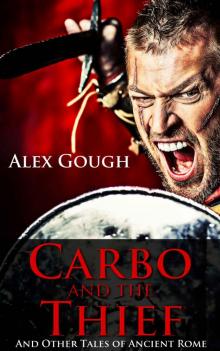
Emperors fate, p.1
Emperor's Fate, page 1


Emperor’s Fate
Cover
Title Page
Dedication
Chapter I
Chapter II
Chapter III
Chapter IV
Chapter V
Chapter VI
Chapter VII
Chapter VIII
Chapter IX
Chapter X
Chapter XI
Chapter XII
Chapter XIII
Chapter XIV
Chapter XV
Chapter XVI
Chapter XVII
Epilogue I
Epilogue II
Author’s Note
Bibliography and Further Reading
Acknowledgements
About the Author
Also by Alex Gough
Copyright
Cover
Table of Contents
Start of Content
To Abbie and Nome
To all my readers for getting this far through Silus’ journey
And to little Ivy, constant companion, still going, against all odds, like Issa
Chapter I
Alexandria, December 215 AD
Silus squinted at the piece of graffiti scratched into the plaster on the side of the Temple of Isis, the distance of an arrow flight from the Great Harbour of Alexandria. He tilted his head to one side, trying to work out exactly what two figures were doing with each other. He traced his fingers over the angular writing beneath the picture, and his lips moved as he deciphered the Greek letters. Then his eyes widened, and he whispered, ‘Fuck!’
Now he knew what the words said, the intention of the unknown artist became clearer. It was a cartoonish depiction of a man and woman in a sexual position, the quality about the standard of a child’s scribble. But the inscription clearly read, ‘Tarautas and Jocasta.’
A couple of young Alexandrian lads saw him examining the image. One nudged the other and wandered over to Silus.
‘Pretty life-like, huh?’ said one in Greek, a sneering smile on his face.
Silus raised an eyebrow. ‘You think? If that’s what you believe sex is like, you have clearly never taken a woman to bed.’
The young man puffed his chest out, put his shoulders back.
‘I’ve had plenty of women.’
‘Sure, I bet your mother had plenty of nannies for you, to keep you out of her way while she screwed some good Roman men.’
The Alexandrian stepped forward, but his friend put a hand on his shoulder, holding him back.
‘He’s just trying to provoke you. Leave him.’
‘I’m not afraid of him.’
‘I know, but look, he’s clearly Roman. Touch him, and the legionaries will beat you black and blue.’
The first Alexandrian glowered at Silus, then turned and stalked away, his friend hurrying behind.
‘Tell your mother I said hello,’ Silus called after them, but they didn’t turn back. Silus shook his head. Oclatinius would have been disgusted with him. He was meant to be keeping his head down. But something in the cocky boy’s demeanour, and his clear approval of the disparaging artwork, had riled him. And it wasn’t because of righteous indignation on behalf of Caracalla, he realised. It was because of the insult to Julia Domna.
Tarautas was a gladiator, as famous for his bloodthirstiness and recklessness as he was for his hideously ugly visage and short stature. There had been a joke going around the Empire for some time comparing Caracalla to Tarautas, and it was even possible to purchase statuettes outside the Flavian amphitheatre of a stunted Caracalla dressed as a gladiator, his handsome features twisted unkindly. As for the reference to Jocasta, even Silus’ meagre literary education informed him this referred to the mother and lover of the unfortunate Oedipus.
If Caracalla saw it, of course, he would explode like Vesuvius.
And Caracalla was due to tour Alexandria the next day. Currently he was resting with his men in the Roman camp to the east of the city, having marched many hundreds of miles from Syria. He had left his stepmother, Julia Domna, the graffitist’s Jocasta, in Antioch, in charge of the administration of the East, while he turned his attention to Egypt. It was another step on the ladder that reached up to the invasion of Parthia, his ultimate aim. Having pacified Britannia and Germania, consolidated his position in Rome, and defeated the barbarians of the Danube, he simply needed to deal with a belligerent Armenia and a grumbling Alexandria, and the invasion could proceed.
Armenia was a technically independent vassal state of Rome, but bordering Parthia, it was a constant bone of contention, shifting from the influence of one Empire to the other depending on who was on the throne. It would have to be dealt with before the operation against Parthia could begin.
Alexandria was a different proposition, however. Since the reign of Augustus Caesar it had been an Imperial province, and though in all that time it had never been in outright rebellion against Roman rule, it was constantly simmering, and often boiling over into open riots. Caracalla had resolved to ensure the passivity of this vital part of the Roman Empire prior to continuing his adventure, and also, Oclatinius had informed Silus, to raise funds which were running dangerously low, despite his liberal bleeding of the richest of the Roman elite.
The city had a feel of unrest now, Silus thought, as he strolled nonchalantly into the agora, the wide meeting place and market that was the Greek equivalent of the Roman forum. Philosophers and prophets stood on the steps of temples and sermonised to passers-by with threats of doom if they didn’t turn from their evil ways or delivered unsought advice on how to live a fulfilled life. Stallholders cried out for custom, advertising their fresh fish, fruits, perfumes, shoes, jewellery and slaves. Prostitutes propositioned lone males, and in some cases accompanied males, much to the disgust of their partners.
But there were others hanging around with less clear purposes. Groups of men skulked, looking sullen, leaning against walls, carving inscriptions, throwing stones, with occasional fights breaking out between them. Women and old men shot them concerned glances and rushed to complete their business, so they could hurry home, ushering oblivious children and grandchildren before them.
Silus had been in Alexandria before and had found himself in the midst of a full-blown riot. He knew how easy it was for this city to explode, and the presence of Caracalla with his army outside the city was more like pouring oil on a fire than on troubled waters.
But that was not Silus’ problem at that moment. He had been tasked with keeping tabs on an Imperial freedman called Eugenios. Formerly, Eugenios had worked closely with Festus, the late Commander of the Sacred Bedchamber and head of one of Caracalla’s spy organisations. His successor was the freedman eunuch Sempronius Rufus, who had already been the Head of the Bureau of Memoirs, and Oclatinius was suspicious of the man’s increasing power and the trust shown in him by Caracalla. Eugenios was now in Rufus’ employ, but an informer had passed intelligence to Oclatinius that Eugenios was conspiring against Caracalla. Whether he was involved with the conspirators who had supported Festus and were never found, or was acting under orders from Rufus, or there was some other conspiracy brewing, Oclatinius did not know, and he had tasked Silus with finding out.
Eugenios was a short man, which was irritating when it came to tailing someone. He disappeared in and out of the crowd, and Silus had to stick closer to him than he liked to avoid losing him completely. Silus had cut his teeth tracking wolves and deer in northern Britannia under his father’s cruel and judgemental tutelage and graduated to hunting barbarian Caledonian and Maeatae. Tracking a man through a city had obvious differences, but the basics were the same, and, besides, Silus had had much experience since he had joined the Arcani.
So he was able to follow Eugenios from the Roman camp, through the Canopic Gate, down the Canopic Way and past the gymnasium and the Temple of Saturn to this spot. Eugenios occasionally stopped abruptly, took a random turn or loitered at a market stall. But his craft was clumsy, amateurish, and he showed no signs of noting his tail.
Silus followed him through the agora and out of the southern side, and up the hill to where the magnificent Serapeum overlooked the city. The temple complex dedicated to Serapis held bad memories for Silus, the site of the culmination of Julia Soaemias’ plot to make her son Avitus ruler of the East. But that had had a happy ending, more or less, and he put it from his mind as he slipped through the colonnaded garden, keeping Eugenios in sight the whole time. The Imperial freedman gave one final glance around him, then knocked a complex rhythm on a wooden door in a small temple dedicated to Anubis, which was situated in the Serapeum complex. The door opened just enough to admit Eugenios, and he squeezed inside.
The temple had no ground level windows and only the single entrance. Silus didn’t like the idea of climbing up to the openings under the rafters to enable him to observe what was happening inside. Clambering up temple walls was hardly the best way to stay inconspicuous, and, besides, Eugenios could leave and be away before he could get back down. So instead, he took up the position of a meditative worshipper at a nearby altar, kneeling so he could keep the temple entrance in view.
A seller of sacrifices approached Silus, dragging with him a small menagerie. Despite the fact that Silus was clearly in the middle of an act of worship the sacrifice-seller started to harangue him in native Egyptian accented Greek.
‘Doves, sir? Pure white, no marks. I personally guarantee the liver will be free of lesions.’
Silus half-closed his eyes and pressed his hands together before him .
‘New-born kid? Pure white. The best price, sir.’ The kid bleated on cue, and a caged dove let out a coo.
‘Go away,’ hissed Silus.
‘Something more impressive to honour Serapis? I can get you a full-grown bull, best price in Alexandria, healthy. I can even get you the priest to do the sacrifice, good omens or your money back.’
Silus pulled aside a fold of his tunic to reveal his blade, and the sacrifice-seller backed away hurriedly.
The door to the temple opened and half a dozen figures emerged, Eugenios among them. The others were typical Greek Alexandrians in appearance, complexions lighter than the native Egyptians, apparel finer in quality than the poorer indigenous peoples. Silus kept his head bowed until they had passed, then scurried over to the temple. He eased the door open quietly and peered in. The interior was dimly lit by the few lofty apertures allowing in the sunlight. The air was cool and thick with the scent of incense. But there was nobody inside, so he hurried to catch up with the group who had left a moment before.
The men walked, deep in muttered conversation, glancing around them furtively as they processed back down the hill towards the city centre. It was much harder to avoid detection by an alert group than an individual because of simple mathematics – at any one time someone was more likely to be looking in the pursuer’s direction. So Silus had to hang back a lot further than he would have liked, unable to hear their words, and frequently losing sight of them.
When they reached the busy crossroads of the Aspendia Avenue and the Canopic Way at the south-west corner of the agora, they halted. Silus turned to face a wall where more graffiti was inscribed, and studied it, keeping the group at the edge of his vision. It was another uncomplimentary message directed at Caracalla: ‘Go home Caracalla, brother killer.’ Not much subtlety there. The anger in the city was palpable. Silus thought it would take even less provocation than usual for it to boil over, and he had witnessed a riot after Atius accidentally kicked a cat.
The group of men split, heading in pairs south, east and west. Silus followed Eugenios and his new partner, a tall, skinny man with a shaven head, wearing a priestly robe, maybe a celebrant of Isis or Serapis. They walked east down the Canopic Way. The avenue was wide, lined with olive trees and cedars, carts, wagons, litters and chariots passing each other in a seemingly chaotic fashion that nevertheless succeeded in keeping the vehicles moving. Pedestrians dodged in and out of the traffic, and the busy throng allowed Silus to approach his quarry much closer.
He was curious now. Oclatinius had clearly been right, as always. Eugenios was definitely up to something, and this furtiveness suggested whatever it was, he shouldn’t be doing it. Of course, it might be something illicit that had nothing to do with Caracalla, or conspiracies against the Imperial person. He could be attending a meeting of a banned or secret cult, conducting some shady business deal, arranging a theft. But Silus doubted if he would be that lucky. It was bound to be something worse.
Pockets of restless men were gathered along the roadside, and Eugenios and the priest stopped several times to talk to them. Silus couldn’t hear the words, but he saw angry nods and clenched fists. The uneasy feeling in Silus’ guts intensified.
A pregnant woman jumped out of the way of a grain wagon that had veered to avoid a cat. She bumped into Silus, then fell onto her backside, spilling her basket of loaves into the dirt. Silus blurted out an apology and bent to help her up.
‘Go home, Roman,’ she spat, batting away his proffered hand. Silus was taken aback. He was hardly wearing a toga and spouting Latin speeches, but neither had he dressed as an Alexandrian. He had supposed there would have been enough Romans in Alexandria that he wouldn’t stand out, and certainly the last time he had been in the city, he had attracted little attention. The mood towards Romans had clearly changed. Maybe it was fear of Caracalla’s army, anger at his announcement to tax them heavily to pay for his war, or maybe it was just typical Alexandrian volatility. But Silus had clearly miscalculated.
As he stepped back from the woman uncertainly, an old man waved a stick at him, and cried out, ‘Leave her alone, Roman. Can’t you see she is pregnant?’
Silus turned to him to protest his innocence, stepping forward and spreading his hands wide.
‘Look, he is harassing that old man now,’ shouted a plump woman.
Three young men who had been lounging against a wall, throwing pebbles at a sleeping dog, nudged each other and wandered over to him, shoulders rolling, arms away from their sides in a way subconsciously calculated to exaggerate their bulk.
‘Hey,’ called out one. ‘Want to pick on someone who can fight back?’
‘No, listen,’ said Silus desperately, glancing towards Eugenios and the priest who were a score of yards down the road, talking to a stallholder who was selling kitchen knives. ‘It was an accident. She slipped.’
‘They all say that,’ said another youth, and pushed him hard in the shoulder. ‘Oh look, did you slip?’
Silus clenched his jaw.
‘I don’t want any trouble.’
‘You should have thought of that.’ The youth drew his fist back, swung a punch aimed at Silus’ temple.
Silus caught the fist in his hand, twisted, slammed down with his elbow and broke the lad’s arm.
The scream cut through the hubbub of the street, and everyone nearby stopped and stared. Silus looked across to Eugenios who was looking in his direction and frowning.
Maybe if Eugenios hadn’t recognised him, he would have dismissed it as simply another street brawl. And there were very few people in the extent of the Empire who would know Silus, and what he did. He gave no public speeches, there were no busts of his likeness, he appeared on no coins. But those in the Emperor’s inner circle knew well exactly who he was, and Silus saw the realisation of his identity hit Eugenios.
‘Run,’ yelled the freedman to the priest, and they both broke into a sprint.
The uninjured youths tried to grab Silus, but he brushed them aside and charged off after the fleeing men. The stallholder that Eugenios had been talking to threw a wooden crate into Silus’ path as he passed, but Silus hurdled it and continued uninterrupted.
Eugenios and the priest passed another small group of idle men and yelled to them, ‘Help, the Roman is trying to rob us!’
The men, four of them, stepped across Silus’ path, jaws set, fists enclosed in palms.
Silus leapt onto the back of a cart full of watermelons. His feet sank into the juicy fruits with a squelch, and he almost tumbled headlong. Windmilling his arms, he kept his balance, stepped up onto the side of the cart, then onto the yoked ox’s back. The driver yelled a protest at him, and the ox let out a long low, then Silus jumped back down, bypassing the men obstructing him. They shouted curses at him as he left them behind.
Eugenios looked back, eyes wide in alarm, and urged the priest to a greater speed. The priest gestured to an alley between two residential buildings. They took the corner and disappeared momentarily from sight. When Silus reached the alley, it was empty.
He ran on for a moment, thinking maybe they had reached the end and turned another corner before he had got there. But he soon realised that they weren’t that quick. He stopped, looked around.
There were entrances to the buildings on either side of the alley. On one side the door was shut and barred. On the other side the door was open, with a chained dog inside the vestibule, fast asleep. There was no way two men had run past the canine without waking it, unless it was deaf, or dead.
He took a few steps back, then barged into the locked door with his shoulder.
The wooden door burst apart and Silus flew through. A startled porter in the vestibule raised his hands in protest but did not have time to stand before Silus had clamped a hand around his throat.
‘Which way did they go?’
The porter’s wide eyes darted left and right, seeking help. Silus squeezed. The porter gurgled and pointed through the atrium towards the peristylium. Silus let go and ran through. The porter slid off his stool, clutching his neck and breathing hard.
A startled slave girl who was polishing a marble bust screamed at the sight of him and knocked the bust off its pedestal so it fell to the ground with a crash. It didn’t matter, Silus had sacrificed stealth for speed.